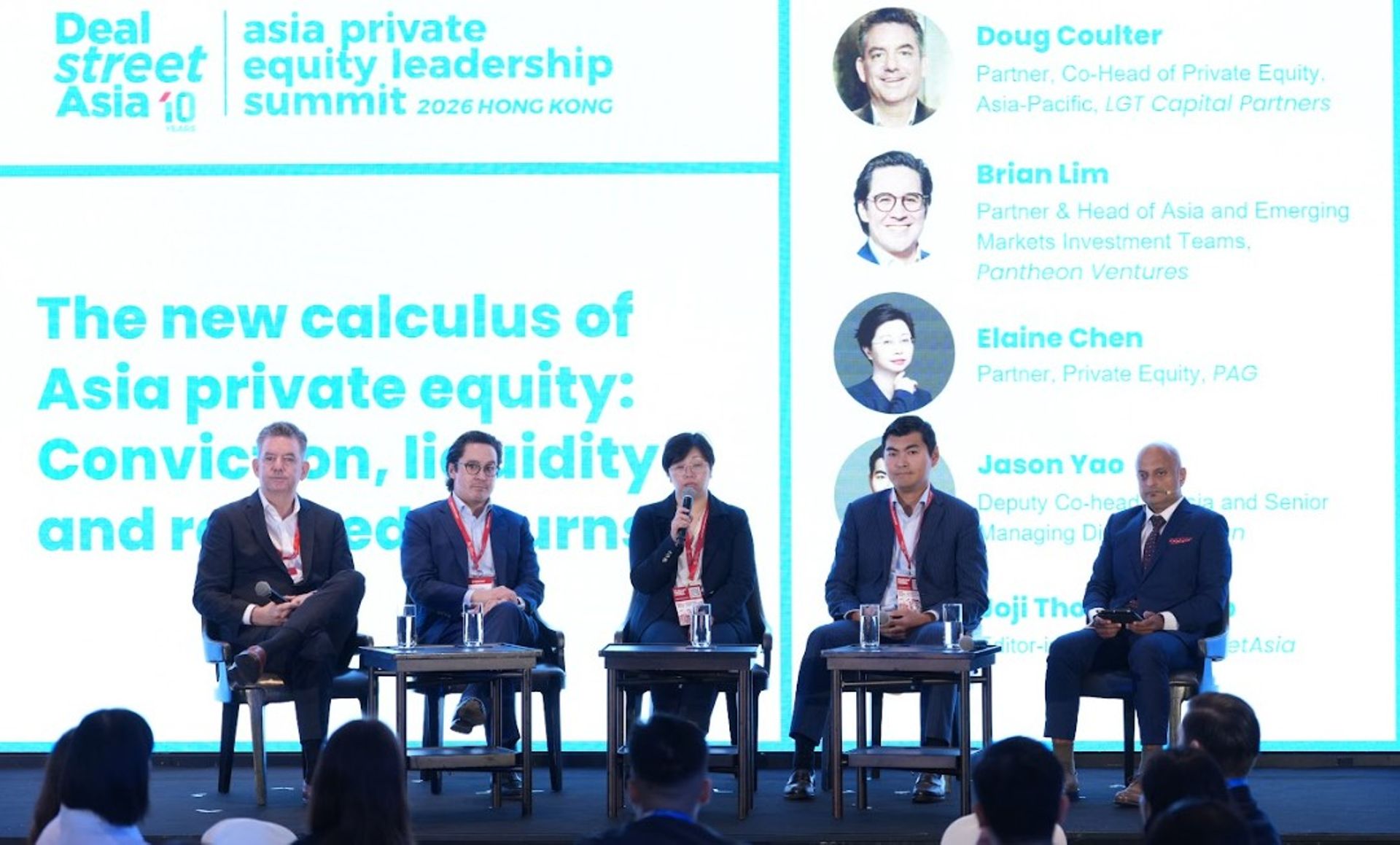
Private equity investors are reassessing how they allocate capital to Asia as the region shows early signs of improved liquidity, but limited partners are still waiting for stronger evidence of realised returns, executives said at DealStreetAsia’s inaugural Asia Private Equity Leadership Summit in Hong Kong on Wednesday.
Speaking during the session titled “The new calculus of Asia private equity: Conviction, liquidity and realized returns”, executives from LGT Capital Partners, Pantheon Ventures, PAG, and Ardian said the region remains attractive, but investors are becoming more selective after years of weak exits and uneven performance.
Asked whether Asia’s recovery was real or temporary, Doug Coulter, co-head of private equity, Asia Pacific, at LGT Capital Partners, said, “The shorter answer is I don’t know.”
“Both LPs and GPs are struggling a little bit trying to figure out what the right strategy is for Asia.”
Coulter said Asian private equity had been heavily shaped by China, particularly during the 2010-2021 period when Western LPs chased the country’s growth story.
But he said the industry should return to “something very boring, which is diversification”.
Coulter also pointed out that India and Japan have emerged as the region’s strongest markets over the past 2-3 years, though investors must remain selective. “If you liked India in 2025, you should love India in 2026,” he said, while warning that excessive capital inflows into parts of Asia could again drive valuations too high.
LGT Capital Partners’ committed and invested private equity investments in Asia total $10 billion.
Brian Lim, partner and head of Asia and emerging markets investment teams at Pantheon Ventures, said the recovery still looks uneven.
“We see green shoots of that happening across different markets, but I think we need to see more variety in terms of these exits.”
Lim said that investors also need to see liquidity flow beyond only marquee assets. He added that pricing remains a hurdle even as market sentiment improves.
Valuation expectations between buyers and sellers have adjusted “in some ways,” he said, but deal numbers remain down, suggesting that buyers and sellers may still not be “fully getting there in terms of price expectations”.
Pantheon announced the final close of GP-led secondaries fund with total commitments reaching $1.1 billion last year. It has approximately $11.3 billion in assets under management across its flagship PE secondaries funds.
Elaine Chen, partner, private equity, at PAG, said GPs must make decisions based on fundamentals rather than market sentiment.
“You have to be able to build your convictions based on the market trends at the very fundamental level. Everybody has to eat.”
Chen was referring to PAG’s investments in the food sector during tougher market conditions. She added that PAG is seeing stronger deal and exit activity despite broader caution.
“We see very strong activity levels in the deal space,” she said, adding that the firm has “about four companies actively engineering for exit” and that the buyer universe is “much stronger than before”.
PAG has three core strategies: credit and markets, private equity, and real assets.
Jason Yao, deputy co-head of Asia and senior managing director at Ardian, said secondaries are becoming more attractive in Asia because of liquidity needs and limited dedicated capital. “You can really choose the best of the assets,” he said, adding that secondaries offer buyers more visibility than primary commitments.
Yao added that Asia’s secondary market remains less mature than the US and Europe, creating opportunities for buyers.
“The infrastructure overall here is still developing,” he said, adding that the market still involves “a lot of proprietary bilateral discussion” where buyers can work closely with GPs to select assets and negotiate pricing.
Ardian raised a record $20 billion last year for its next-generation fund dedicated to energy, transport, and digital connectivity in Europe.