Southeast Asia is attracting billions of dollars to build the infrastructure behind artificial intelligence. Whether the region can turn that investment into technology companies of its own is a harder question.
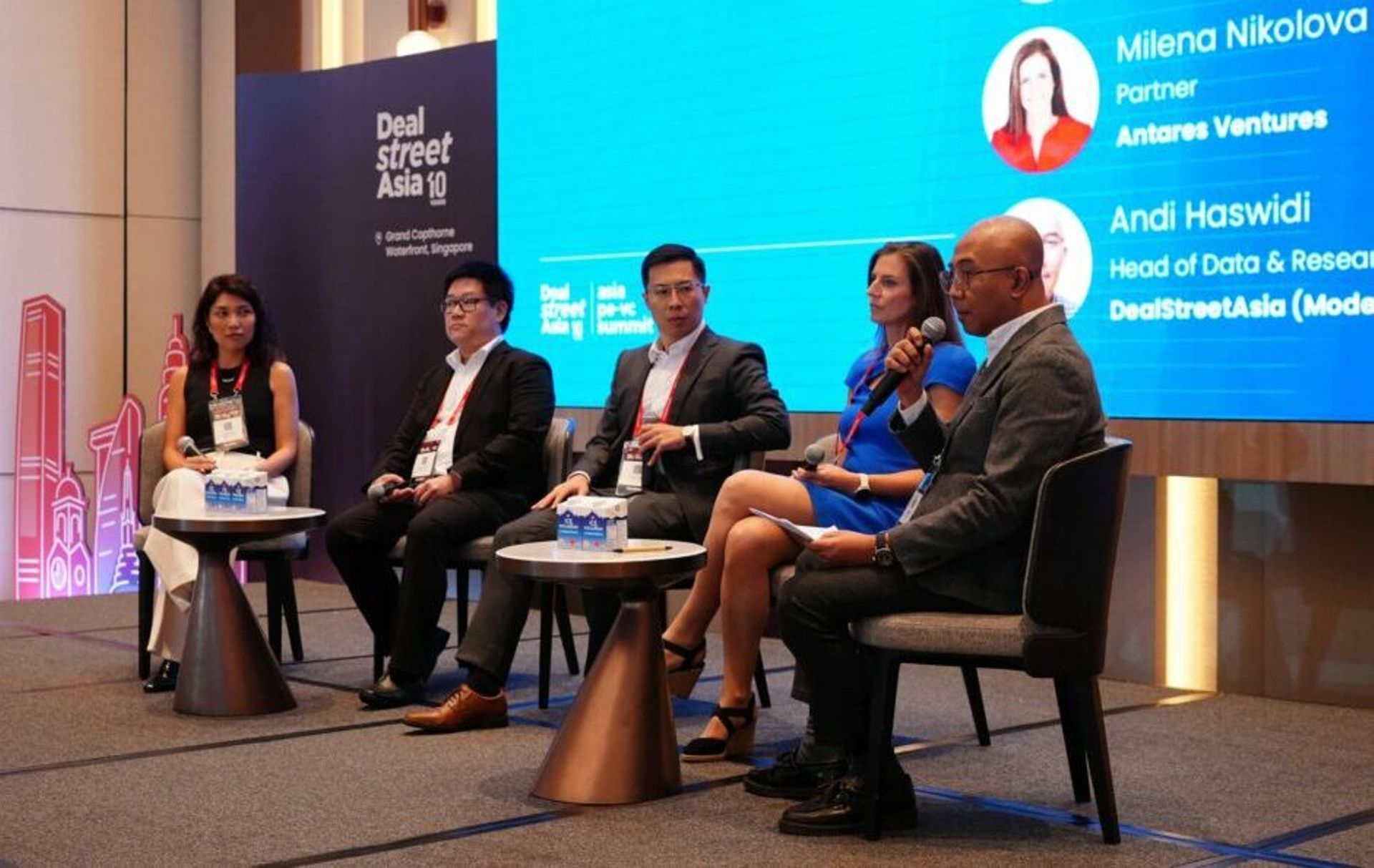
That was the challenge raised by investors at the panel ‘Can Asia’s deep-tech race turn national ambition into global scale?‘ at DealStreetAsia’s Asia PE-VC Summit in Singapore on Sept. 24: how to use foreign capital to build on Southeast Asia’s manufacturing strengths, develop local expertise and bring products to market that customers will pay for.
“To attract foreign direct investment, it cannot just be money,” said Jeep Kline, founder and managing partner of Raisewell Ventures. “I think data centres are great. They’re here to stay. But it cannot just be money. If the money comes to use the region’s resources, there has to be something else behind it: perhaps intellectual property, a commercialisation opportunity or a new kind of manufacturing that engineers graduating from Southeast Asian universities can learn from,” she added.
The distinction matters as money flows into digital infrastructure. Southeast Asia accounted for about half of all data-centre capacity under construction in Asia Pacific in the first half of 2026, up from 31% at the end of 2025, according to Cushman & Wakefield. Malaysia had 1,039 MW under construction and Thailand 859 MW, led by projects in Johor and Bangkok.
Kline said Southeast Asia could gain more from AI investment if local engineers learn how to turn research into products and develop new manufacturing processes.
She drew a parallel with Japan’s automotive industry, whose growth helped create production networks across Asia. Physical AI and robotics could offer a similar opening, she said. Raisewell has invested in a Japan-based robotics company.
For Kline, the aim is for investment to set off a wider cycle of innovation. Engineers could “take that knowledge, build applications on top and create innovation of our own,” she said.
Build on the region’s strengths
Raymond Woo, Singapore office representative of Kyoto University and its venture capital arm Kyoto iCAP, also argued for starting with the region’s existing strengths.
“Southeast Asia is fragmented. We have 700 million people, but it’s very diverse. Even collectively, we are perhaps too small in the AI infrastructure world. For Southeast Asian countries, it’s more of an application market. What are our strengths? Our strength is manufacturing hardware,” Woo said. “We want to make that more efficient, so Southeast Asia can climb up the value chain,” he added.
He sees greater scope for Southeast Asian companies to apply AI in factories and other industries, making production more efficient and helping businesses move into higher-value activities.
Malaysia offers one example of the manufacturing base Woo described. The country approved 16.6 billion ringgit ($3.9 billion) in electrical and electronics investments in the first half of 2026, according to its investment development authority. The sector includes semiconductor activity, although the figure covers a wider range of electronics projects.
Richard Yang, managing partner at Sinovation, pointed to another advantage beyond Southeast Asia’s manufacturing base: its position between major technology markets. He said the region could serve as a base for companies seeking to connect technology and customers across Asia and the West.
“Geographically, this [SE Asia] is the spot where the East and the West would meet and communicate on technology.”
“Geographically, this is the spot where the East and the West would meet and communicate on technology,” he said. “If we want to find a middle ground, let’s just say between the US and China, I think it’s here. And it’s actually happening. Some of our portfolio companies have set up their regional headquarters in Singapore, serving top US pharmaceutical companies. The other way, there are data centres in Singapore and Southeast Asia helping Chinese companies train their models. So it goes both ways.”
Turn technology into paying customers
That position could create opportunities beyond serving Southeast Asian customers. But the investors said companies still need to demonstrate that their technology solves a problem for a buyer, rather than relying on interest in AI to carry a product to market.
Woo said commercialisation can be particularly difficult for research-led companies. What holds technical founders back from winning customers, he argued, is often “a human element”.
He said technical founders in the deep tech sector can be “very obsessed with technology, at the expense of market validation, at the expense of customers”. Building a product people will pay for calls for skills beyond research and engineering, he argued.
“It takes a team to make magic happen… I would advise them to get more entrepreneurial co-founders or business people or other C-suite officers. They will do the business of it well; the founder or the engineering talents will focus on the engineering,” Woo said.
Milena Nikolova, a partner at Antares Ventures, said customer economics shape which technologies can scale in Southeast Asia. Products need to meet local price requirements and, where possible, fit into infrastructure that companies already operate. Building an entirely new system may demand more capital than a potential customer is willing to spend.
“What is the price point? How does it retrofit existing infrastructure?” she said, describing the questions Antares asks when assessing technologies for the region. She cited equipment that could be added to an existing industrial plant and new hardware that could work within current power infrastructure.
The AI buildout has also brought some companies customers they did not initially set out to serve. None of Antares’ nine portfolio companies began with a plan to work with data centres, Nikolova said, but six now do. Demand associated with data centres has created a market for technologies developed to solve other industrial problems, she said.
For Kline, attracting more of the investment and expertise needed to build such companies will also require Southeast Asian markets to be easier to operate across. She cited the cost of setting up a company in Singapore, differences in tax treatment and barriers to hiring skilled workers across borders.
“If a company that invested in Singapore wants to hire someone immediately in Thailand or Vietnam, we should act as one country if they are entrepreneurs or knowledge workers.”
“If a company that invested in Singapore wants to hire someone immediately in Thailand or Vietnam, we should act as one country if they are entrepreneurs or knowledge workers,” she said.
The panellists differed on where the strongest businesses might emerge: Kline pointed to the transfer of know-how through investment, Woo to industrial applications and commercialisation, Yang to robotics and cross-border customers, and Nikolova to technologies that meet a clear need at the right price.
All four, however, returned to the same measure of success. Southeast Asia can attract AI spending, but capturing more of its value will depend on whether companies in the region can build products and find paying customers for them.