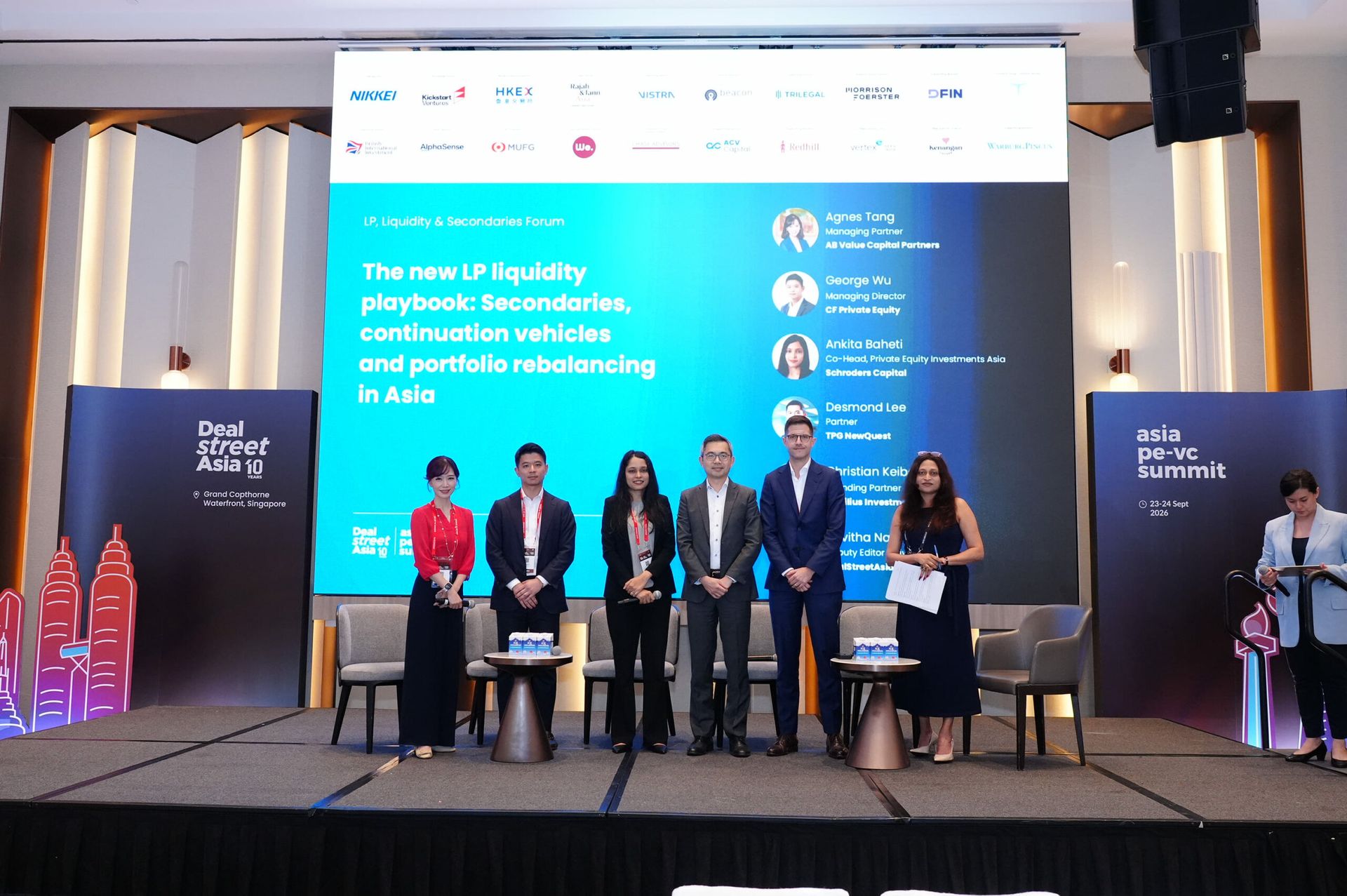
Asia’s secondaries market is seeing a changing mix of sellers, with more corporations and family offices coming to market, according to Agnes Tang, Managing Partner at AB Value.
This is changing how buyers assess a transaction. “The opportunity for me is increasingly about matching the right capital with the right situations,” Tang said during a panel discussion at the Asia PE-VC Summit in Singapore last week.
The market is also becoming more segmented across Asia, with different exit environments and levels of maturity seen in China, Japan, Taiwan, Southeast Asia and India.
More sophisticated sellers are taking a longer-term view of their portfolios to reshape exposures, reduce concentration and rebalance geographically.
For Christian Keiber, Founding Partner, Aquilius Investment Partners, understanding the reasons behind a sale is particularly important because sellers do not always come to market to maximise price.
“We always try to move any conversation with a seller from ‘What can I pay, what’s the discount?’ to ‘What specific liquidity need do you have, and how can I engineer that solution for you?’” he said.
In Asia, the market has less available capital and is less intermediated. Asia-Pacific secondaries is dominated by overseas sellers, Keiber said. Their decisions are “reporting-based,” whereas buyers of Asian secondaries look at the performance of the underlying assets.
Liquidity dynamics
While the need for liquidity is real across the secondary market, the price and terms may be below sellers’ expectations. “So the gap in expectations between a seller and a secondary buyer can be quite wide,” said Keiber.
From a buyer’s perspective, George Wu, Managing Director at CF Private Equity, added that the net asset value is “just a starting point for negotiations”.
Different fund managers have different valuation policies, Wu said, and buyers also need to understand the risk profile of what they are buying — whether it is a single company or a portfolio. Time and GP alignment matter too. Even for high-quality assets, if there is not enough time for the company to compound, that will limit the upside and affect the price a buyer is willing to pay.
GPs that have not hit their preferred return “may not be incentivised to maximise value”, Wu said.
Beyond NAV, the question for buyers is really about the trade-off between price and quality.
“The goal as a buyer is to find a mismatch between price and quality, and the way you do that is by using your edge, the things that make you unique,” explained Wu.
Private-market valuations do not necessarily determine where a secondary transaction clears. Valuations are typically updated quarterly or semi-annually, while buyers may be working with financial information that is already several months old. In auction and brokered processes, pricing can also be shaped by the number of competing buyers, information gaps and the dynamics of a particular transaction.
“Fundamental value is very important, because it informs buyers what their maximum price should be. But in many cases, pricing in the secondaries market has more to do with game theory than with fundamental analysis,” Wu said.
In the LP-led market, Wu explained that when purchasing an LP stake, the fund manager, or GP, has to approve each buyer. Higher-quality GPs with good track records and stable LP bases tend to be more restrictive about who they allow into their funds as buyers, he said. For a secondaries buyer with access to those higher-quality GPs, it becomes much easier to find that mismatch because the universe of available buyers is significantly more limited.
“And if you combine that edge with a focus on the more inefficient parts of the market – such as smaller transactions – you can find some interesting opportunities where the trade-off between price and quality is much less significant.”
Desmond Lee, Partner at TPG NewQuest, said the firm looks at GP-led transactions, or continuation deals, very differently from how a secondaries investor approaches an LP-led transaction.
A continuation vehicle is not simply a way for GPs to move assets they cannot sell because of fund life, Lee asserted. For TPG NewQuest, an asset has to have a high growth trajectory to warrant a CV.
“So when we talk about a mature asset, it may not be a ‘mature’ asset, because that has the connotation that the asset has reached the end of its cycle. Instead, we look for assets that, given another three, four or five years of runway, can grow further.”
Lee said TPG NewQuest had also done several CVs that provided new growth capital to the underlying asset, requiring strong GP conviction that additional time and capital could allow the asset to double or triple its actual cash return.
Lee explained the decision for LPs depends partly on their profile and expected distributions over a given period. Pricing is one consideration, with LPs assessing whether the price at which the CV transacts is fair, while conviction in the underlying asset is another.
In a CV transaction, LPs can choose whether to take liquidity or roll into the vehicle, typically for another four to five years, he said. Where the asset is among the GP’s best-performing investments, LPs may share the GP’s conviction and choose to roll if they see scope for further returns.
“But by and large, in CV transactions we do see a certain preference among LPs for taking money off the table, partly because of how we typically structure CV transactions.”
LP View
Ankita Baheti, Co-Head, Private Equity Investments Asia at Schroders Capital, said the decision to take liquidity or continue holding an asset involves two considerations: the investment and the fund.
On the investment side, LPs look at pricing in the secondaries market, the quality of the underlying asset or portfolio, the upside or value-creation potential compared with what was originally underwritten and what has been achieved so far, and the exit options available in future.
Exit options are particularly important in Asia, where they vary across sectors and geographies, Baheti said. If a strategic sale has been delayed, or is likely to be delayed, LPs need to consider whether another credible exit option will become available in the next few years, or whether the asset could become illiquid and need to be held for a longer period.
Fund considerations include how much liquidity the original fund needs and whether there are other strategic considerations, such as an LP being over-exposed to a particular sector or geography. An LP may therefore choose to sell even if the investment considerations are fine, Baheti said.
A continuation vehicle can allow LPs to sell a proportion of their position and roll the remainder, she said. It can also provide more information on how the company is performing and how its valuation is determined, rather than relying on a headline NAV and applying a discount.
Secondary solutions
The range of considerations in a secondary transaction is also reflected in how deals are structured, with Keiber noting that such deals are becoming more common.
In Aquilius’ business, probably one in three secondary transactions is structured. These can include deferrals, earn-outs, strip sales and preferred equity.
Where there is a disconnect between buyer and seller on pricing, or where a seller wants a clean exit, that typically lends itself to a straight sale, Keiber said. Where there are disconnects over valuation, visibility of cash flows or when liquidity is needed, it lends itself more to a specialist structured solution, which can include earn-outs, strip sales, deferrals and preferred equity.
The shift towards more complex transactions is also changing the role of the secondaries investor, Keiber said, from an investor acquiring discounted fund interests to a “customised liquidity provider”.
As transactions move closer to the asset level, investors need the capability to underwrite individual assets, including their performance and exit prospects, rather than taking only a fund-level view. Local resources are also important in Asia, given differences in tax regimes, legal frameworks and foreign ownership restrictions across markets, he said.
“So the ability to make local decisions and act with speed, certainty and conviction is a critical differentiator between being a secondaries investor and being a real solutions provider in this space.”
Tang framed the liquidity decision more broadly, with a focus on the cost of continuing to hold an asset. “For an LP, liquidity is not simply an exit decision; it’s an allocation decision,” she said. LPs need to consider the realistic path to cash, what they are being paid to wait and what else they could do with the capital today.