In this edition, we examine how the US restrictions on chip access can disrupt SE Asia’s data centre and AI boom, which is riding on enormous dry powder and big-ticket project financing.
From India, we look at how consolidation and platform-building in financial services might be private capital’s next big bet.
Where US chip curbs bite first
The global rush for computing power has turned Asia’s data centres into multibillion-dollar prizes. In 2026 alone, DayOne raised $4.5 billion in fresh equity for its expansion, while KKR and Singtel agreed to pay S6.6 billion (US$5.1 billion) for the remaining 82% of ST Telemedia Global Data Centres.
Now the US has given investors a reason to ask what those billions are riding on. A data centre can open on time, with the power on and a customer ready to pay. Whether that customer can switch on the chips may still depend on a licence from Washington.
Until this week, Chinese AI companies could rent computing power from advanced Nvidia chips mostly in Southeast Asia, as US export controls made those chips hard to buy and bring into China. A company in China, for example, could run an AI model on Nvidia chips sitting in a Malaysian data centre. That made Southeast Asia a natural place to serve customers with an appetite for computing power and limited access to the chips that supplied it.
The arrangement came under scrutiny when Nvidia co-founder Jensen Huang resigned as CEO following questions about his ties to a former executive at Megaspeed International.
Earlier this week, the US Commerce Department’s Bureau of Industry and Security issued an interim final rule restricting remote access to certain advanced AI chips. Under the rule, data centre operators need a US licence to provide computing power from those chips above a specified threshold to companies headquartered in China, Macau or other restricted markets. The licensing requirement applies even when the chips stay in Southeast Asia.
The rule also tightens controls on where the chips can go. Washington now requires a licence to ship covered chips to Malaysia, Singapore, Thailand, Indonesia and Brazil.
The first place these new chip rules are likely to bite is not directly on construction and building, but in the financing of Asia’s data centres, where billions in equity and private credit now hinge on how much computing power operators can still sell.
“The first sign of stress may be a loan that doesn’t close, rather than a data centre that shuts down,” Bob Chua, founder of NTRY.AI, a market intelligence platform that covers data centres across Asia-Pacific and the Middle East, told DealStreetAsia.
DayOne, for example, expanded its bank financing for its Johor data centres to about $7.2 billion in October. The loan agreement, which DayOne made public in its US IPO filing, requires a “Finance Service Coverage Ratio of at least one point two (1.2) times”. This means that the borrower needs $1.20 in project earnings and designated reserves for every $1 in debt payments. The extra 20 cents gives the banks a cushion in case of delayed revenues and cost overruns. The borrower must still meet that test after paying certain dividends.
That is how a licensing delay could reach shareholders while a data centre keeps running. If a customer starts paying later than expected, the borrower could still have enough to pay the banks and fall short of the cushion it needs to pay certain dividends.
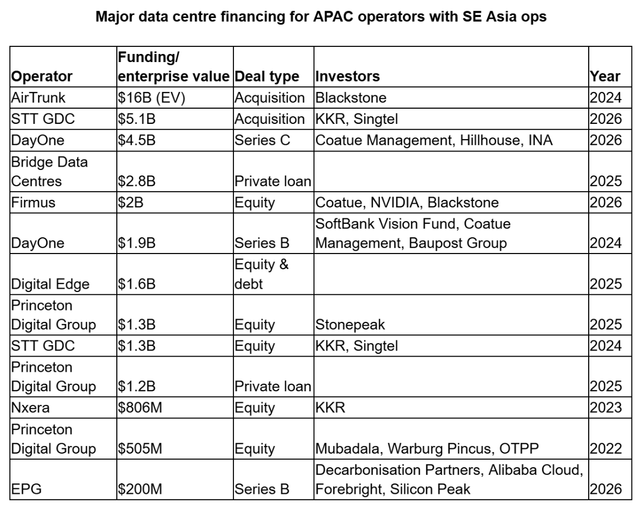
The investors behind these deals range from the growth funds and sovereign capital backing DayOne to the infrastructure investors buying into its peers. Coatue and Hillhouse led DayOne’s latest equity round, which also brought in the Indonesia Investment Authority. Stonepeak invested in Princeton Digital Group, while KKR and Singtel took full control of ST Telemedia Global Data Centres. On the lending side, DayOne’s Johor financing brought together seven banks, including Maybank, DBS and Standard Chartered.
Southeast Asia has been here before. Chinese solar manufacturers built factories in Malaysia, Vietnam, Thailand and Cambodia to serve markets including the US. In 2025, Washington imposed steep duties on solar imports from those four countries. The lesson for data centre investors is that a facility can sit thousands of miles from China and still find its economics reshaped by US trade policy.
Chua said some Chinese AI firms may move workloads home and adapt their models to domestic chips, while others may stay in Southeast Asia and switch hardware. “If customers pull back faster than operators can find replacements, some GPU clusters in Malaysia or Singapore could sit underused even as new chip deliveries slow,” he said.
“I’d watch GPU rental rates first,” he added.
A drop in GPU rental rates would give investors a sense of what it costs to replace a customer. A data centre can sell the same amount of computing power and bring in less revenue if it has to cut prices to fill the racks. The debt payments still come due, and shareholders may have to wait longer for a payout.
For the billions backing Southeast Asia’s data centres, the test is whether operators can find customers who are allowed to use the chips and willing to pay the rates the projects were financed on.
PEs eye consolidation play in India’s financial services
Even as PE fund managers become more selective about where they park their capital, one sector in India continues to draw the biggest cheques: financial services.
Finance is no longer the preserve of a relatively small, affluent section of the population. More Indians are borrowing, investing, saving and accessing financial products. From credit and insurance to wealth management and stockbroking, financial services are becoming part of everyday life.
Just last week, Singapore’s Temasek agreed to invest $267 million in Godrej Industries’ financial services arm, while global investment firm Blackstone announced that it would acquire a 16% stake in IIFL Finance for $535 million. Meanwhile, Canada’s Fairfax Financial Holdings has reportedly sold its entire stake in the company through a $375 million block deal.
Interestingly, these are not merely opportunistic, deal-by-deal bets. They reflect a broader investment thesis: India’s financial services market is expanding, becoming more sophisticated and offering opportunities across multiple segments.
“Banking and financial services are one of the best leveraged proxies for India’s growth story,” said Manish Kejriwal, founder and managing partner at Kedaara Capital, pointing to opportunities spanning banks, NBFCs, insurance and asset management.
But the opportunity is not just about backing the next promising lender or financial services business. An equally interesting possibility is taking shape in consolidation potential.
India’s financial services market remains fragmented, with several players operating in overlapping segments. As businesses mature and competition intensifies, the next phase of growth could come from bringing these businesses together, combining customer networks, distribution capabilities and technology to build larger, more competitive platforms.
For PE investors, this offers another route to create value: acquiring smaller businesses, building scale and extracting synergies rather than always starting from scratch.
There are already signs of increased dealmaking. M&A in financial services was valued at $2.25 billion in the third quarter of 2026, up 54% from $1.45 billion in the preceding quarter, according to Grant Thornton Bharat. The value stood at $296 million in the first quarter.
“Over the next few years, I expect consolidation around scaled platforms, more control and growth-capital deals, and valuations that increasingly reward governance, risk and compliance maturity, not just loan-book growth,” said Vivek Iyer, partner and financial services risk advisory leader at Grant Thornton Bharat.
The next big opportunity, then, may not be about finding one more promising financial services company. It could be about finding several and putting them together to build the next big platform.
Top Developments
Fundraising
Noveon Capital, a new Asia-focused secondaries investment firm, has been launched by private equity executives from Carlyle and Warburg Pincus.
Jelawang Capital has backed its next cohort of six emerging managers, including Bintang Capital Partners, Sitara Capital, Qualgro Ventures and Jungle Ventures.
Allocator One, a fund-of-funds investing in emerging managers, has closed its debut flagship fund at more than $100 million, and plans to expand in the APAC region.
Deals
Oman Investment Authority has joined a $200 million funding round in Chinese automation firm MegaRobo Technologies. Other investors include CMB International, Asia Investment Capital, Granite Asia and Sinovation Ventures.
Warburg Pincus will acquire 38.51% of Pricol Autotech, the automotive electronics business of Indian auto components maker Pricol, with plans to further consolidate its ownership in the company.
Exits
Indonesia Investment Authority is looking to offload a 27% stake in its portfolio of four Indonesian toll-road assets, having hired Rothschild & Co to advise the transaction.
Canada’s Fairfax has reportedly sold its entire stake in India’s IIFL Finance for $375 million through a block deal. Separately, Blackstone said it will invest $535 million in the non-bank lender.