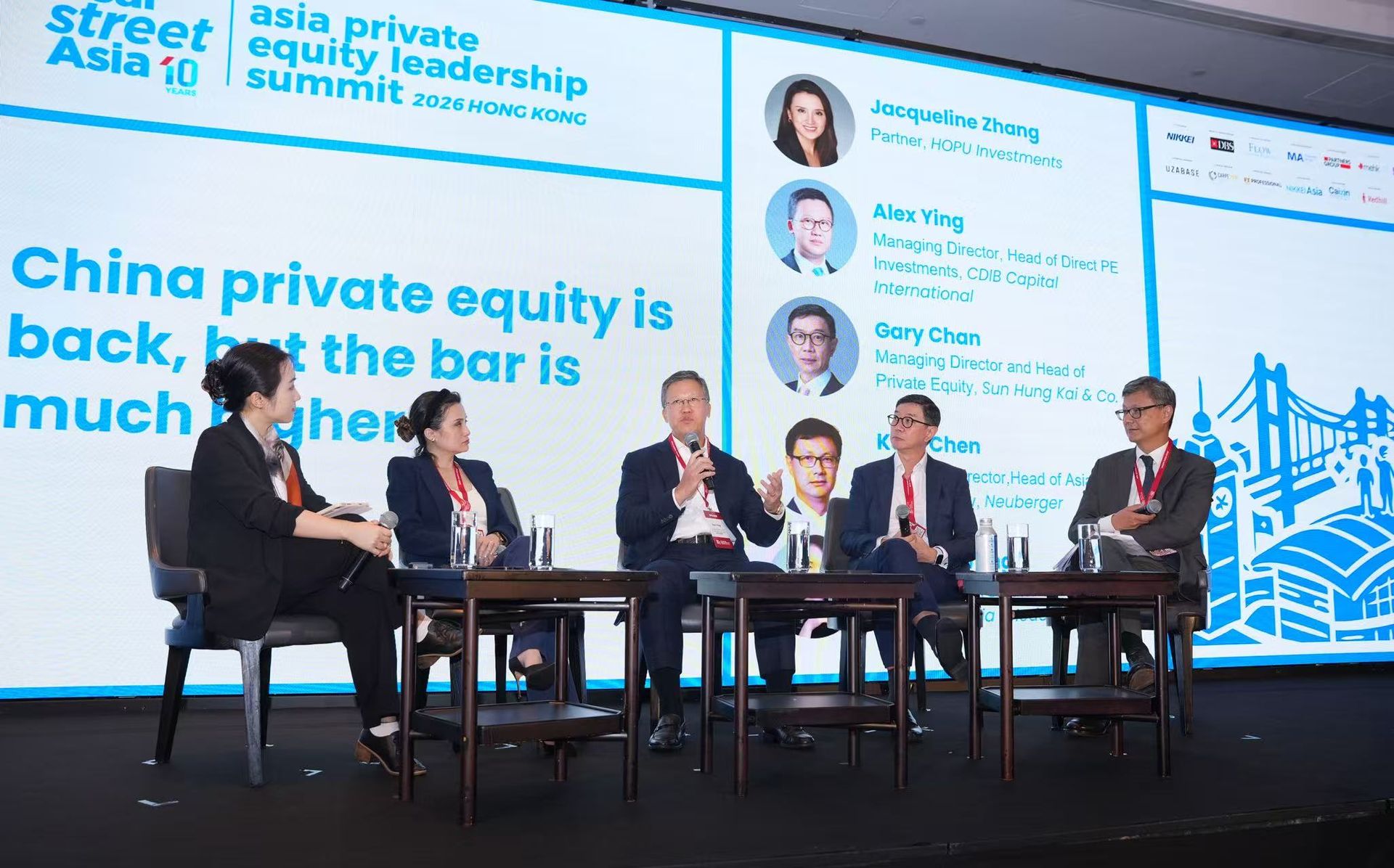
After a painful few years, China’s private equity (PE) market is finally drawing renewed interest from global investors, but the path to thrive is only reserved for a select few as the era of easy money fades.
Speaking at DealStreetAsia’s inaugural Asia PE Leadership Summit on May 20 in Hong Kong, general partners (GPs) and limited partners (LPs) painted a picture of a market in recovery–but one defined by selectivity, where only investors with structured exit capabilities and operational expertise can win.
“From our perspective as an LP, we are seeing a lot more Chinese GPs in the last 12-18 months… Within our portfolio, some GPs are doing extremely well in the Chinese market,” said Gary Chan, managing director and head of PE at Hong Kong-based alternative investment platform Sun Hung Kai & Co. “But I would say it’s very selective.”
Driving this recovering sentiment is a strong 2025, when dealmaking and exit activities in Greater China both posted year-on-year gains. Notably, a total of 5,211 exit cases were recorded in the Chinese PE market last year, a 42% year-on-year (YoY) increase, according to a Deloitte report citing Zero2IPO data.
While IPO exits rebounded after a consecutive slowdown during the three years from 2021 to 2024, trade sales, redemptions, and M&A exits in China grew steadily last year, the report shows.

As an indicator of the warming PE environment, the number of newly registered PE and VC funds in 2025 increased by 19% YoY in 2025, while total fundraising went up 13% to reach 304.8 billion yuan ($44.8 billion), according to the Asset Management Association of China (AMAC).
“The Chinese economy has gone through basically all sorts of stress tests that you can imagine, from the trade war and COVID to policy reset and US sanctions,” said Kent Chen, managing director and head of Asia PE at Neuberger Berman. “Public and private market valuations have come down, and they are nowhere near the peak. From a valuation point of view, this is still an attractive moment to look at China.”
The appealing valuation level is combined with new growth engines emerging from the country’s tech sectors, like advanced manufacturing, green tech, artificial intelligence (AI), and robotics, said Chen.
However, much of the recovery is still driven by local currency investors and state capital. Foreign money remains highly selective in China.
Only a handful of tech-focused venture funds–including Luminous Ventures, Lanchi Ventures, Monolith Management, as well as Source Code Capital and its VC platform SCV–have successfully raised fresh dry powder in US dollars in recent months.
“What would move the needle, in my opinion, is that people would like to see a bit more exits and full deal returns,” said Alex Ying, managing director and head of direct PE investments at CDIB Capital International.
“What [the market] has gone through in the past three to four years was quite painful… [to an extent that] people don’t believe that you can make returns in China anymore,” said Ying.
And as this market matures, achieving target returns now requires significantly stronger earnings growth than in the past. As how Bain & Co. partners put it, “12 is the new five,” which means delivering 20%+ IRR now requires about 12% annual EBITDA growth versus 5% a decade ago.
“I see it as not so much a headwind, but a moat for the folks who know what they are doing,” said Ying. “For us, the most important thing is to answer: Why are we the right buyer for a particular asset? The main thing is how we are differentiated from other GPs.”
Addressing the perennial exit challenge, Jacqueline Zhang, a partner of HOPU Investments, said that geographic diversification across multiple Asian markets has helped the firm navigate the ebb and flow of China’s exit environment.
HOPU, which returned $1.2 billion to LPs in 2025, saw exits from its latest HOPU USD Master Fund III in H1 of the year come almost entirely from its non-China portfolio, while H2 exits featured a strong China component.
“The best way to ask for a cheque is by returning it in the first place,” said Zhang.
As China makes strides in AI and robotics, she highlighted a dichotomy where the hesitant re-entry of global capital colliding with rapid on-the-ground tech innovation and operating efficiency at scale has created “compelling situations.”
“China’s corporate landscape is relatively young. But for the first time in over two decades, we’re seeing good businesses coming out for sale,” said Zhang. Multinational corporations recalibrating their Chinese exposure and cross-border control deals involving Chinese-owned orphan assets are creating a robust pipeline for PE investors who “understand both sides.”
“If it is a business where you can find defensible cash flow and long-term compounding potential, LPs are always very interested,” said Zhang.