This edition looks at how new sources of energy are powering demand in fast-growing markets, with a particular focus on nuclear fusion.
We also examine SE Asia’s energy investment activity, which has grown to surpass $100 billion in 2025, driven by significant investment in renewable energy, electricity grids, storage, and electrification. Yet, the region captures only about 3% to 4% of global energy investment.
From nuclear to the grid
For emerging markets, economic growth and increasing demand for power go hand in hand. It will require adding alternative energy to the grid, with capacity expansion across all sources of power.
In Southeast Asia, where economic expansion remains closely tied to emissions growth, the challenge is particularly acute. It is important for businesses and investors to embrace new growth drivers such as AI, but even more important to expand in a responsible and sustainable way.
Energy and climate tech investors participating in the recently concluded Asia PE-VC Summit 2026 see Southeast Asia advancing with new technologies and business models, but requiring innovation and capital to support the growth.
Stefano Ghezzi, managing director at Brookfield Energy, said the narrative had evolved from energy transition to energy addition. Rather than focusing solely on replacing existing sources, the priority is to expand supply to meet growing demand.
“We need all of these technologies – renewables, storage and batteries, gas, and nuclear,” Ghezzi said.
Nuclear fusion, in particular, could offer a compelling long-term solution. It produces no carbon emissions during operation and has the potential to scale significantly, he added.
Nuclear fusion is the process by which two light atomic nuclei combine to form a single heavier one while releasing massive amounts of energy, according to a definition by the International Atomic Energy Agency.
Beyond its potential to deliver low-carbon electricity, fusion benefits from the abundance of its potential fuel sources, said Milena Nikolova, partner at Antares Ventures.
Still, Andrew Wong, director at TRIREC, suggested that a reactor connected to the grid and capable of producing power at commercial scale might not emerge until 2028 or even later. But while nuclear fusion has yet to establish a commercial foothold in Southeast Asia, governments across the region are actively exploring the technology, he said.
Globally, the nuclear fusion ecosystem has attracted an estimated $17-19 billion in investment. Investors could begin to see exits within a five-to-10-year horizon, as heard at FusionX Singapore last week.
While nuclear fusion requires a longer investment horizon, it can still offer investors quite significant augmented valuations. TRIREC, for instance, invested in US-based Type One Energy in 2023 when the company was valued at around $40 million. The fusion developer has recently completed a $200-million Series B round at a pre-money valuation of $900 million.
For fusion technologies to gain traction in Southeast Asia, however, technological progress alone will not be enough. The region will need regulatory frameworks and incentives that make projects commercially viable and bankable. The private sector will then definitely step in, said Ghezzi.
For Brookfield’s broader energy investments in Southeast Asia, the firm focuses on the key markets of the Philippines, Vietnam, Malaysia, Thailand, and Indonesia.
With strong economic fundamentals and rapid growth, these markets are at a tipping point where they require foreign investment and capabilities to build up energy sustainability, Ghezzi noted. Regulatory frameworks have also been put in place to make energy infrastructure investment faster, he added.
Climate tech still attractive
Climate technology may be increasingly discussed through the “sexier” labelling of food security, data sovereignty, or energy sovereignty. But the underlying driver remains much the same: the need to meet growing demand while addressing environmental challenges, according to Marie Cheong, founding partner of 100×100.
Data centre development is emerging as a particularly powerful catalyst. Beyond creating demand for energy and infrastructure, the sector is also opening up new commercialisation pathways for technologies that were not originally developed with data centres in mind.
Nikolova illustrated the trend through Antares Ventures’ portfolio. Of the nine companies in its current fund, none initially set out to address problems specific to data centres or semiconductors. Yet, six are now finding their fastest routes to commercialisation in those sectors.
“What we are observing is that this capex supercycle is working as a tailwind in climate tech,” she said.
More broadly, there are a lot of challenges, but at the same time, solutions exist.
However, Cheong pointed out, progress remains constrained by misaligned incentives or insufficient market adoption, while startups should fill the gap and deliver at scale.
Another bottleneck, as Cheong put it, is a “top of the funnel problem” with the lack of early-stage investments. “You need that early-stage pipeline in order to invest in later-stage deals,” she said.
For climate investments, it is important to finance and develop a deeper pool of early-stage companies as the next generation of investable assets.
Who is funding Southeast Asia’s energy sector?
In a recent meeting in Manila, energy ministers from the Association of Southeast Asian Nations pledged to ramp up clean energy generation, even as the countries continued to look at stockpiling oil amid supply disruptions from the conflict in the Gulf. The ministers also agreed to ramp up the development of the regional ASEAN Power Grid, nearly 30 years after it was first mooted.
The ASEAN Energy Investment 2026 report released by the body the week before the ministers’ meeting showed that ASEAN’s energy investment has grown to surpass $100 billion in 2025, driven by significant funding in renewable energy, electricity grids, storage, and electrification.
Yet, the region captures only about 3% to 4% of global energy investment, and even then more has gone to fossil fuel investments; around 4% of fossil-fuel investment and 3% of clean-energy investment. This is despite the region accounting for about 5% of global energy demand and 9% of the global population.
Indeed, investment in Southeast Asia’s energy sector – including from foreign direct investment (FDI), development financing and the associated so-called mobilised private capital inflow – remains woefully inadequate, as noted in the report.
The table showing the top 10 recipients of mobilised private finance in the energy sector illustrates the relatively limited scale of private capital mobilised through development-finance interventions in ASEAN’s energy sector.
Top 10 recipients of mobilised private finance – Energy sector, 2021-2024
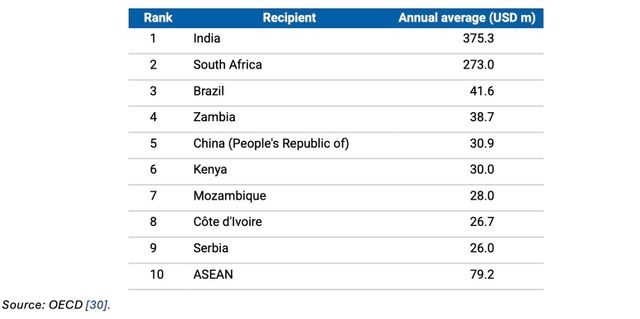
At the same time, development finance-supported private investment is concentrated in a limited number of markets.
Between 2012 and 2023, Indonesia and Vietnam accounted for about 71% of the regional total, at around $318 million and $294 million, respectively. However, during 2021–2023, the Philippines emerged as the largest recipient, attracting approximately $98 million.
Private Finance Mobilised for the Energy Sector by Country
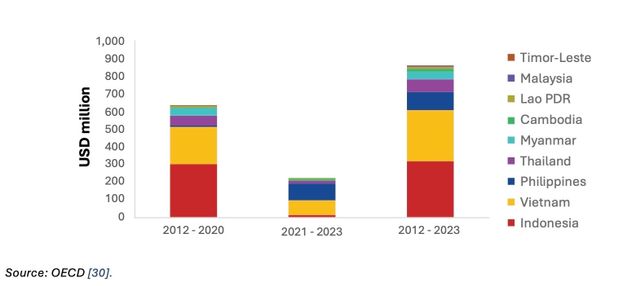
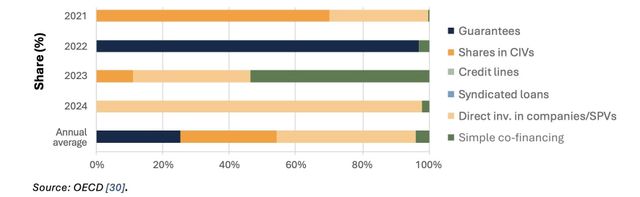
Further, when looking at the financing mechanisms used to mobilise private capital, the report noted that the capital flows are highly transaction-driven – with specific projects or facilities skewing the activity in any given year – rather than a market with diversified and consistent deployment.
For instance, between 2021 and 2024, direct investment in companies or special-purpose vehicles represented the largest share of mobilisation on average, at around 42%, followed by shares in collective investment vehicles at 29%, and guarantees at 25%. However, the annual composition varied substantially.
Mobilised Private Finance by Leveraging Mechanism, ASEAN energy sector, 2021-2024
In terms of markets where the investments were, the Philippines stood out, accounting for nine of the 13 major renewable energy deals valued at more than $500 million in 2024. Key transactions included Actis’s $600 million purchase of a 40% stake in Terra Solar in the Philippines, and its investment in a 139 MW solar project in Thailand.
The Philippines and Malaysia together accounted for 25 of the region’s 49 major project-finance deals in 2024, mainly in electricity generation, battery production, and critical-minerals mining and processing.
Notably, a number of countries in the region are part of clean energy manufacturing and critical minerals supply chains, making it an important destination for energy-related FDI. Vietnam, Thailand and Malaysia are among the leading solar-PV manufacturers globally after China.
Indonesia, which produces more than 60% of the world’s nickel, attracted over $50 billion in new mining investment between 2014 and 2023, accounting for more than 90% of global new nickel investment during that period. The report noted that Chinese investment has been key to this: In 2024, China contributed about $30 billion to Indonesia’s nickel refining sector, and Chinese companies now account for around 75% of the country’s nickel-refining capacity.
Ultimately, if foreign capital is needed for ASEAN’s energy transition, strengthening the investment environment becomes key as global capital becomes increasingly concentrated in fewer host economies and strategic sectors such as AI, semiconductors, and critical minerals.
Climate tech deals in Southeast Asia
Three early-stage startups bagged funding in September.
Singapore green packaging firm N&E Innovations raised more than $1.7 million in an investment round led by Tundra Capital, while recycling startup Life Lab Resources secured $1 million in pre-Series A financing.
Lumio Solar in the Philippines also raised a pre-seed round from early-stage VC firm 100×100.