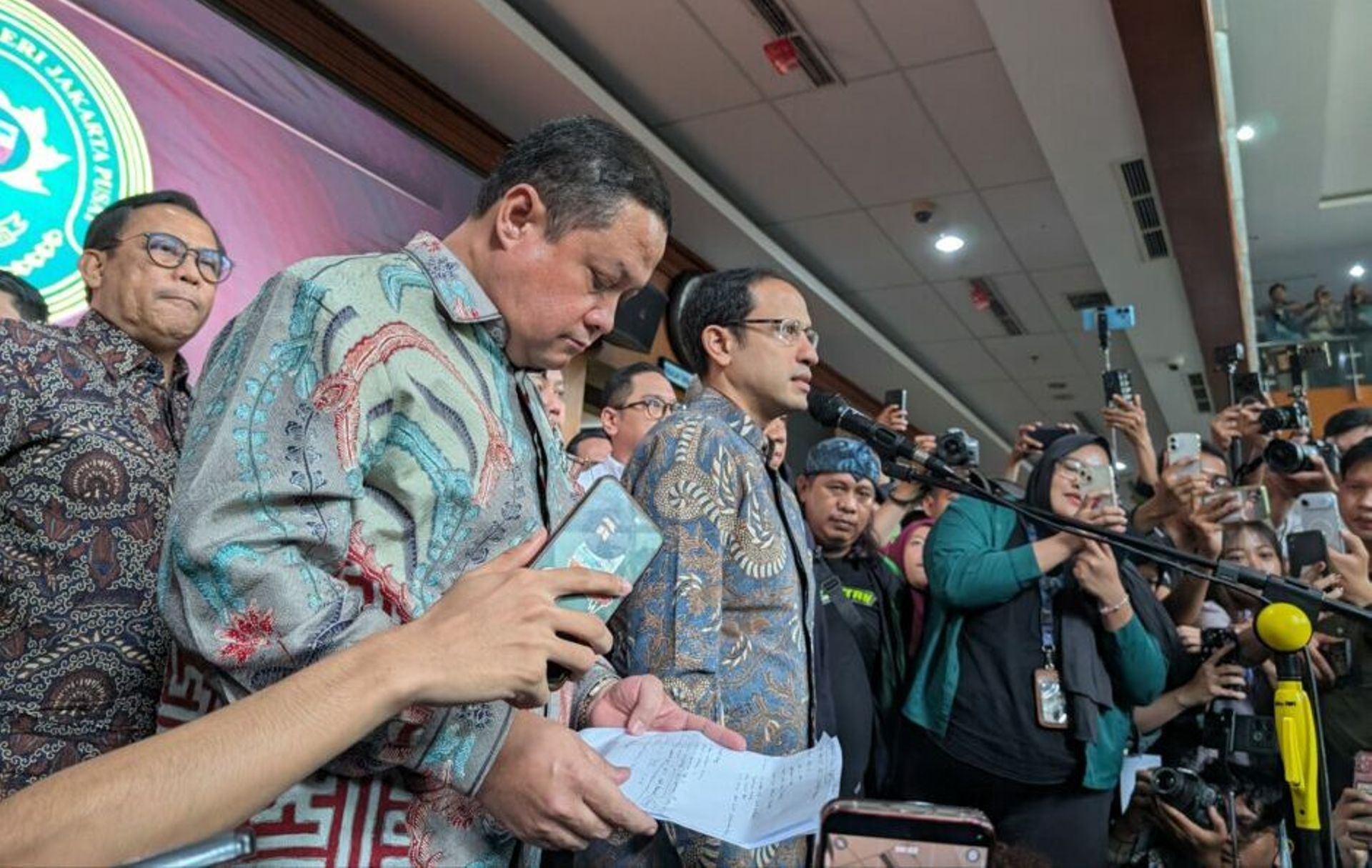
Former Indonesian education minister and Gojek founder Nadiem Anwar Makarim was sentenced to 10 years in prison on Monday (June 30) in a graft case related to the procurement of Chromebook laptops. The Central Jakarta District Court found Makarim guilty under a subsidiary corruption charge, while acquitting him of the primary charge.
The prison term was lighter than the 18-year sentence sought by prosecutors in May. Prosecutors had also demanded a 1 billion rupiah ($55,800) fine and replacement payments totalling around 5.6 trillion rupiah ($313 million), comprising 809 billion rupiah allegedly linked to the case and another 4.8 trillion rupiah based on the reported value of his assets.
Besides the prison term, the court imposed a 1 billion rupiah fine, which must be paid within one month after the verdict becomes legally binding. It also ordered Makarim to pay 809 billion rupiah in replacement money.
If the payment is not made within one month after the ruling takes legal effect, prosecutors may seize and auction his assets. Should the proceeds prove insufficient, he will have to serve an additional five years in prison.
The court also ruled that the time Makarim has spent in detention will be offset toward his sentence, while the period he served under house detention will be counted as one-third of its duration under Indonesian law.
The case stems from the education ministry’s procurement of Google’s Chromebook laptops under its school digitalisation programme between 2020 and 2022. Prosecutors alleged the programme resulted in 1.56 trillion rupiah in state losses and accused Makarim of influencing the ministry’s decision to adopt Chrome OS laptops despite an alleged conflict of interest arising from Google’s investment in Gojek, the ride-hailing company he co-founded before joining the cabinet.
Not a unanimous verdict
The verdict was not unanimous. One out of the five judges—Judge Andi Saputra—issued a dissenting opinion, saying prosecutors had failed to present sufficient evidence to establish criminal intent or prove a causal link between Makarim’s alleged conflict of interest and the Chromebook procurement.
Saputra had also dissented in ruling against technology consultant Ibrahim Arief, another defendant in the case, arguing that Arief should have been acquitted because prosecutors had failed to prove the charges beyond any reasonable doubt.
According to Saputra, corruption cases involving white-collar crimes require particularly rigorous evidence, including proof of causality and mens rea, or criminal intent. He said the evidence presented during the trial failed to meet that threshold.
The judge also questioned prosecutors’ reliance on WhatsApp conversations written in English, arguing that they should have been translated by a sworn translator and examined by a linguistic expert rather than through machine translation.
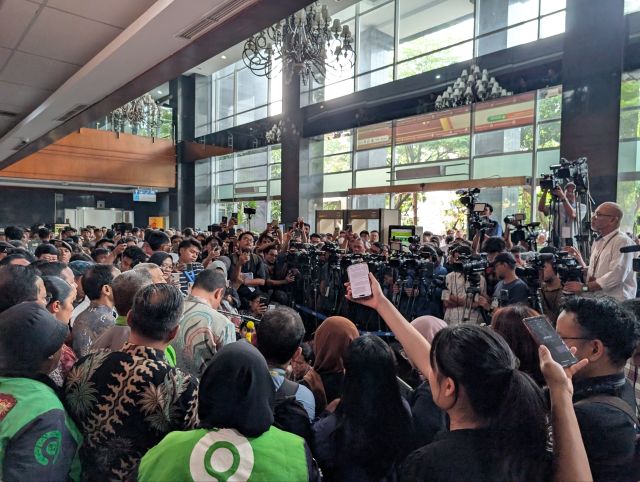
He further found that meetings between ministry officials and Google representatives merely reflected preliminary discussions and did not establish wrongdoing. Likewise, Makarim’s status as a minority shareholder in GoTo did not prove he had manipulated procurement decisions for personal gain.
“The laptop procurement policy, Google’s investment and the increase in the value of the defendant’s shareholdings are three separate events with no causal relationship arising from criminal conduct,” Saputra concluded.
He also found that prosecutors had failed to prove mens rea, which he described as the essential link connecting the alleged conflict of interest to the corruption charges.
Based on those considerations, Judge Saputra concluded that Makarim should have been acquitted of all charges.
Makarim to appeal
Speaking to reporters after the hearing, Makarim criticised the verdict and confirmed that he would appeal. “Today we ask a very big question: Does justice still have meaning? All the facts established during the trial have been ignored,” he said.
Makarim said the dissenting opinion reflected what had actually emerged during the five-month trial. “There is one judge who had the courage to state what the trial actually showed and concluded that I should be acquitted unconditionally,” he said.
The former minister also rejected the court’s order requiring him to pay 809 billion rupiah in replacement money, saying the funds had never been under his control.
“Not a single rupiah of that money ever reached me,” he said, arguing that the transaction involved an internal transfer within GoTo Group that had no connection to the Chromebook procurement or Google. Makarim said he would continue to challenge the ruling through the appeals process.
“I will continue to fight—for my children, for my family, for Indonesia, and for all honest people who have been criminalised,” he said. “I will not stop.”
Throughout the trial, Makarim denied any wrongdoing, maintaining that he never intervened in the procurement process and that the Chromebook policy saved the government at least 3.9 trillion rupiah by lowering procurement costs. He also argued that prosecutors had failed to establish any of the legal elements required to prove corruption.