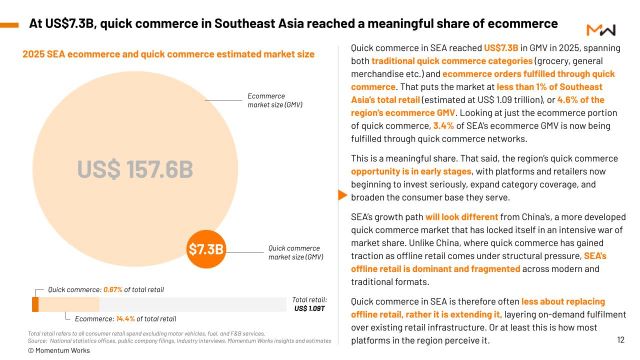
Quick commerce accounted for 4.6% of Southeast Asia’s e-commerce market in 2025 with a gross merchandise value (GMV) of $7.3 billion, according to a new report by Momentum Works.
The report found that e-commerce orders fulfilled through quick commerce networks accounted for 3.4% of Southeast Asia’s e-commerce GMV last year, signalling the growing role of on-demand fulfilment in the region’s digital economy.
Despite the rapid growth, the sector still accounts for less than 1% of Southeast Asia’s overall retail market, indicating that quick commerce remains at an early stage of development in the region.
Momentum Works said the key question for the industry is no longer whether quick commerce will emerge as a meaningful segment, but rather how the model will evolve across Southeast Asia’s fragmented retail landscape.
“While platforms, retailers, and e-commerce players are converging on the same hyperlocal opportunity, the more important observation is how quick commerce will develop in the region—not how big it will get,” the report said.
The study highlighted that Southeast Asia’s quick commerce trajectory differs significantly from markets such as China and India, where the sector expanded under different retail conditions.
In China, years of investment in food delivery networks created dense rider infrastructure that later supported rapid quick commerce expansion. In India, relatively underdeveloped organised retail enabled platform-operated dark stores to effectively serve as modern retail channels for affluent urban consumers.
By contrast, Southeast Asia’s retail environment is already supported by entrenched offline networks, including Indonesia’s minimarket chains, Thailand’s conglomerate-led retail ecosystems, and Singapore’s high penetration of modern trade formats.
As a result, Momentum Works said quick commerce in Southeast Asia is evolving as an extension of existing retail infrastructure rather than a replacement for brick-and-mortar retail.
“Quick commerce here is less about replacing offline retail and more about extending existing retail networks with an on-demand fulfilment layer,” the report said.
The report also suggested that platform-retailer integration will likely matter more in Southeast Asia than the pure first-party or third-party dark store models commonly seen in other markets.
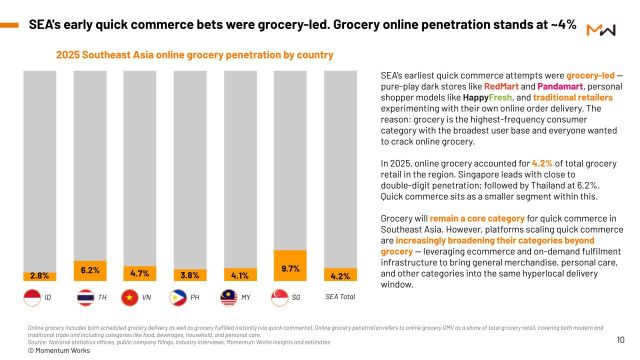
Grocery delivery initially drove the region’s quick commerce expansion due to its high purchase frequency and broad consumer appeal. However, online grocery penetration across Southeast Asia remains relatively low at 4.2%, with Indonesia at the lower end at 2.8% and Singapore at 9.7%.
Momentum Works said platforms are now expanding aggressively into adjacent categories such as personal care, pharmacy, and general merchandise by leveraging the same hyperlocal fulfilment infrastructure.
The report added that quick commerce is emerging as the next major battleground for Southeast Asia’s e-commerce platforms as leading players deepen investments in faster fulfilment capabilities.
Six markets, six playbooks
At the same time, the firm cautioned that Southeast Asia does not lend itself to a single regional operating model. “There is no single regional model that works across SEA,” the report said.
According to Momentum Works, Indonesia’s growth is more likely to be driven by e-commerce platforms than convenience store chains, given the limited incentives for major minimarket operators to aggressively expand quick commerce operations.
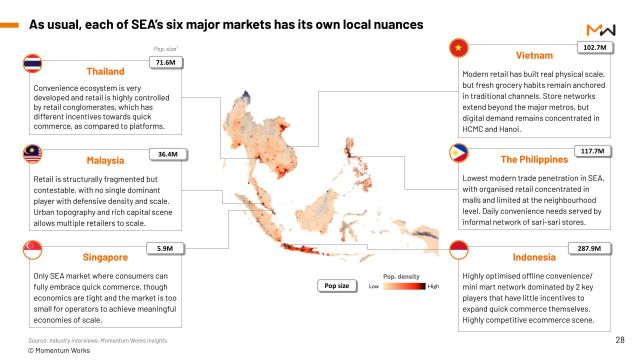
In Thailand, the dominance of large retail conglomerates may favour more specialised or vertical-focused strategies, while Singapore’s market is structurally attractive but constrained by its relatively small size.
Vietnam, Malaysia, and the Philippines each face their own operational and consumer adoption bottlenecks, the report added.
Momentum Works identified consumer demand—rather than logistics infrastructure or supply availability—as the sector’s biggest challenge in Southeast Asia.
While delivery riders, merchant networks, and e-commerce infrastructure are already widely available across much of the region, the report said consumer habits around paying for rapid fulfilment have yet to form at scale.
“Speed is quick commerce’s natural value proposition, but in a structurally price-sensitive region, mass-market adoption requires pricing at or near parity with offline and e-commerce,” the report said. “That takes sustained capital only platforms can currently afford to spend.”