Singapore state investor Temasek Holdings reported a net portfolio value of S$518 billion ($401.1 billion) on a mark-to-market basis for the fiscal year ended March 31, 2026, reaching a new record high.
The net portfolio value was up S$49 billion, or 10.4%, from a year earlier, driven by higher share prices of some Singapore portfolio companies and gains from exits.
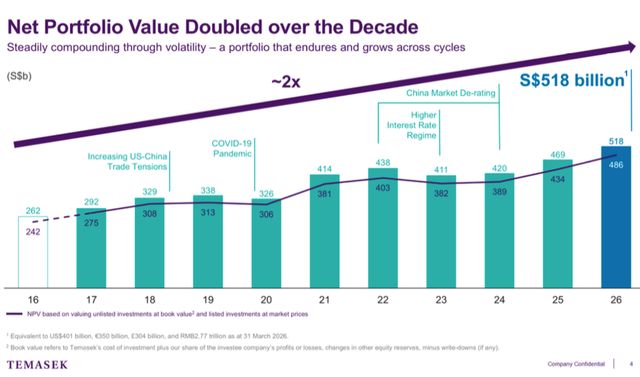
Much of the increase was driven by gains in Temasek’s Singapore-listed portfolio holdings. Shares of DBS Group Holdings rose 22.4% during FY 2026, while Singapore Telecommunications gained 19.2% and ST Engineering climbed 39%.
Temasek divested S$31b across the group during the fiscal year. It also invested S$51b.
Temasek divested S$31 billion across the group during the fiscal year, of which a large portion was from direct investment portfolios of S$24 billion, such as Schneider Electric (5.5 billion euros; $6.2 billion), Axia Vegetable Seeds, and Global Healthcare Exchange. In February, ST Telemedia’s remaining 82% stake in ST Telemedia Global Data Centre was sold to KKR and Singtel for S$6.6 billion at S$13.8 billion valuation in the largest data centre deal in Southeast Asia this year.
The firm invested S$51 billion, of which S$37 billion was in its direct portfolios, including Anthropic, OpenAI, Luckin Coffee, Haldiram’s, ANE, Spectris, and Luminace.
The state investor reported net investments of S$20 billion in its global direct portfolios, which accounted for about three-quarters of Temasek’s investments and divestments during the fiscal period.
The firm reported a one-year total shareholder return of 10.5% as volatility in global public markets triggered by the conflict in the Middle East and the strengthening Singapore dollar weighed on performance.
“Up to the end of February, returns in our public markets’ portfolio were very acceptable based on the size of the portfolio,” said CEO Dilhan Pillay. “Our net portfolio value would have been about 2% higher if not for the impact of these events on public markets,” Temasek said. Most of the losses in its public markets portfolio were recouped in April and May.
One-year returns
The stronger Singapore dollar also trimmed returns by about two percentage points, the firm said. On a constant-currency basis, its one-year total shareholder return was 12.9%, compared with 14.8% when measured in US dollar terms.
Global markets were rattled after the Middle East conflict escalated in late February, fueling geopolitical uncertainty and concerns over oil supplies. President of Temasek Global Investments Nagi Hamiyeh said Temasek’s direct exposure to the Middle East is “very, very small,” with the impact on its portfolio stemming primarily from higher energy prices and broader market volatility.
Temasek’s exposure by geography (%)
| Geography | 2026 | 2025 | 2024 | 2023 | 2022 |
|---|---|---|---|---|---|
| Americas | 26 | 24 | 22 | 21 | 21 |
| Asia Pacific (ex Singapore, China & India) | 11 | 11 | 12 | 11 | 12 |
| China | 17 | 18 | 19 | 22 | 22 |
| Europe, Middle East & Africa | 12 | 12 | 13 | 12 | 12 |
| India | 7 | 8 | 8 | 6 | 6 |
| Singapore | 27 | 27 | 27 | 28 | 27 |
“The 2% is because the energy shock affected the continents at large,” he said. “What’s happening in the region today remains to be seen, what the outcome is, and if it has any permanent impact or not. It’s too early to tell.”
Temasek’s 10-year total shareholder return was 7.1%, while its 5-year total shareholder return was 4.6%, reflecting the drag from China’s capital-market weakness between 2021 and 2024, though returns have strengthened over the past two years following portfolio adjustments.
Singapore-based companies accounted for 43% of Temasek’s portfolio, while global direct investments stood at 38% and partnerships, fund investments, and asset management companies at 19%.
The year’s results mark the completion of its transition to mark-to-market valuation for unlisted investments, bringing its reporting methodology in line with global peers. The annual report is also the first since the firm’s restructuring announced in late 2025, which reorganised its businesses into three segments: global direct investments; Singaporean portfolio companies; and partnerships, funds and asset management companies.