
Are continuation funds just delaying write-downs? Industry experts argue that when structured correctly, alternative liquidity tools could genuinely build long-term portfolio value, particularly in Asia, where these vehicles have some catching up to do.
Asian private markets are navigating a growing tension between the need for liquidity and the desire to hold onto assets longer. Alternative liquidity solutions, including continuation vehicles (CVs), Net Asset Value (NAV) financing and novel structures, are being used to bridge this gap.
At a discussion organised by DealStreetAsia and SS&C Intralinks in Singapore on Sept. 22, a panel representing private-markets professionals with complementary expertise spanning Indian private equity, growth-stage secondaries, NAV financing, and Asia-Pacific secondary investing examined how these structures are developing across the region.
A common scepticism surrounding continuation funds is that they merely allow GPs to delay inevitable write-downs.
However, Abhishek Sharman, founder and MD of Carpediem Capital, argued that CVs are powerful strategic tools when deployed correctly. “We typically only hold on if we can help companies build capacity for a further period from which we are invested. We of course try to play the horizon, but the other element is also very important,” Sharman said.
However, Dominic Goh, MD, HarbourVest Partners introduced a vital caveat. In Asia, where GPs often hold minority stakes, there is a temptation to execute “strip sales”: moving only a portion of their stake into a CV while keeping the old fund invested. Goh urged buyers to insist on clean, full transfers and to ensure GP alignment to avoid conflicts down the line.
NAV financing is gaining significant traction as a bridging mechanism, but Samuel Plagnard, Co-founder and Managing Partner, 𝜏-PAM stressed that it is not a free pass to indefinitely delay exits. “There is a path towards a defined value creation in portfolios by using the funding for bolt-on acquisitions, follow-ons, capex or sometimes a rationalisation of existing financing to lower the cost at the portfolio level. In that case, it’s not about DPI or generating distribution for the LPs,” said Plagnard. Another use case is bridging during an absence of liquidity in the market: for instance, for pre-IPO financing, he added.
The panel unanimously agreed that AI is having a transformational impact on operational heavy lifting, even as there were apprehensions about its tendency to hallucinate. The one area the panel agreed cannot be disrupted by AI is understanding team dynamics, reading a founder’s energy and being able to tap into informal networks of information in the market.
Historically, the secondary market was associated with distressed assets and struggling funds where buyers could command steep discounts. Most secondary trades involve high-quality assets managed by blue-chip GPs seeking portfolio reallocation. Consequently, quality assets in Asia now trade at very slim discounts, driven by future value creation rather than seller distress.
However, geography still impacts pricing power. Piyush Gupta, founder and managing partner, Kenro Capital, said, “In Southeast Asia, it’s very hard for us to underwrite what our eventual exit is going to be. As a fund, we don’t underwrite to M&A. We believe a company ought to be IPO-able, and since Southeast Asia has far fewer data points, we are sometimes left feeling that we are at an intermediate stage and have no clarity on where the stop will be. We have not participated in Southeast Asia, even though it’s part of our mandate due to buyer scarcity.”
The transcript of the discussion titled ‘When exits stall: How private markets are creating liquidity opportunities through continuation funds, NAV finance and new structures’ is below, edited for brevity and clarity:
At what point is creating a continuation fund genuinely value creation? And when is it purely used as a last resort?
Abhishek Sharman (AS): We typically only hold on if we can help companies build capacity for a further period from which we are invested. We of course try to play the horizon, but the other element is also very important: we take 26% plus stakes in the companies we invest in. We can influence them and therefore believe we can structurally help them. Specifically, a vintage which wasn’t the best because of COVID makes for a more interesting backdrop for a continuation fund.
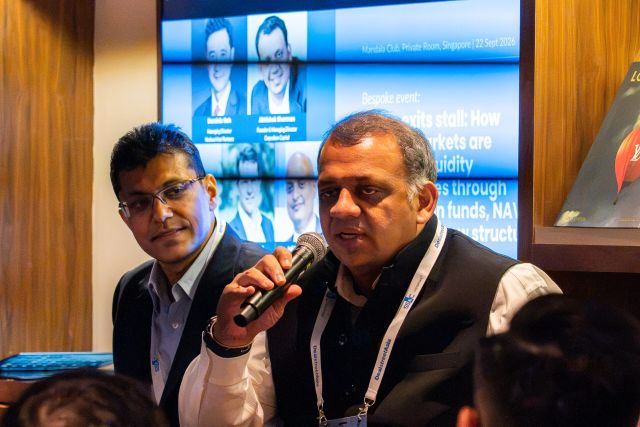
Piyush Gupta (PG): LPs would like to see distributions to paid-in capital (DPI) in older funds before they come into new ones. We found the gap in the market: not enough GPs were focused on direct segments. The continuation vehicle is an easier investment for LPs. We saw the gap: we had to know the assets, the industry, and the ecosystem, and from there we could make direct segments.
Every investment so far has been a partial exit for the shareholders. They like the asset and want to keep compounding it, but they’ve sold us 15-20% of their position to realise NAV and give some DPI to the LPs. That’s a great alignment of interests. For ticket sizes over $50 million to $60 million, there are a lot of growth funds in India that are very comfortable owning great assets. We are playing in the sub-$50 million segment and find very little competition there.
Does NAV financing solve a real timing problem, or is it just postponing an exit?
Samuel Plagnard (SP): As an NAV lender, we provide a temporary layer of liquidity. At some point, we need repayment. The time we give the GP to develop the portfolio must be used productively. The funding can support bolt-on acquisitions, follow-ons, capex or sometimes a rationalisation of existing financing across all the assets of the portfolio. In that case, it’s not about generating DPI for LPs.
The second case is bridging a situation where there is no liquidity in the market. That could, for instance, be pre-IPO financing. But increasingly we see a combination of continuation vehicles and NAV financing. You have GPs and some anchor investors who come along to help develop those trophy assets in the CV fund further, but there is still a shortfall in terms of funding. This is where we can bring an NAV loan on top to help support the growth of portfolios.
India has a hot IPO market. When do you decide an asset goes into a continuation vehicle rather than trying to list or sell it?
AS: IPO markets are hot at certain points and not so hot at others. An asset may be unable to access the IPO market today, but could do so, if allowed to run for a few more years. Valuations in the IPO market improve with scale. The number of potential buyers wanting to buy a pre-IPO or interim round also increases. For us and other GPs focusing on the mid-market, not all companies can readily go public. In that case, playing the horizon and waiting for it to scale makes a lot of sense
Every VC in Southeast Asia is desperate for liquidity. So who has pricing power? Is it the buyer or seller?
PG: In Southeast Asia, it’s very hard for us to estimate what our eventual exit is going to be since we do not underwrite to M&A. We believe a company ought to be IPO-able, and since Southeast Asia has far fewer data points, we sometimes feel that we are at an intermediate stage and have no clarity on where the stop will be. We have not participated in Southeast Asia, even though it’s part of our mandate due to buyer scarcity.
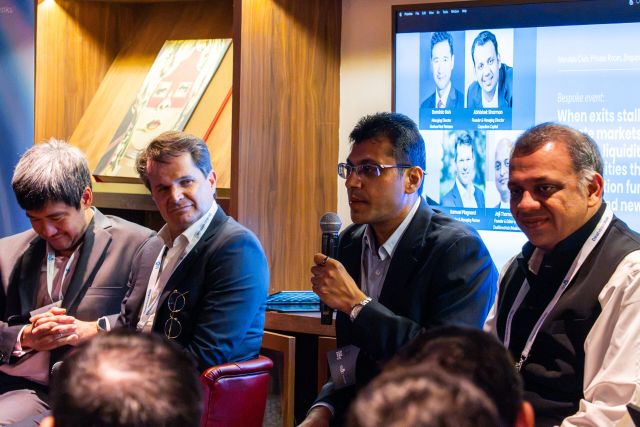
On paper, what makes a portfolio lendable?
SP: You may argue that NAV is just an accounting number. Accounting standards give maybe three or four methodologies to put a price or a value to an asset. But ultimately, what you’re debating is between mark-to-model and mark-to-market.
The former is related to price discovery. In the value of a financial asset on the market, you have a reflection of its actual value at risk. But you also have liquidity premium components, and in the private asset world, it’s a very difficult exercise to distinguish and identify.
From our perspective, the lendability against a portfolio depends very much on turnaround. Our way of structuring net financing is always around the two questions of cash realisation and control.
We are lending against a portfolio which is managed by the GP. We need to be comfortable with their ability to do a proper job in managing assets, realising cash down the road, and creating value.
We do quite a bit of due diligence on GPs: track records in terms of realisation, and governance process. This makes it quite difficult for us to lend to a first-timer.
We then analyse the underlying assets, the portfolio as a whole, diversification, credibility of valuation on each of those assets, and look-through leverage.
Finally, we are literally entering into the structurability of this facility by coming up with a borrowing base. In the context of Asia, it’s a very specific exercise compared to the US or Europe. Asia is very fragmented with some hard constraints like legal access to assets, enforceability of your pledge, cross-border repatriation of cash, FX mismatch…all those aspects make the structuring process much more complex than the U.S. or Europe. But ultimately this internal analysis brings us to the borrowing base which is controlled dynamically over time during lending.
It is very important to make sure that when we define this scenario together with the GP and the LP on why they need liquidity, we keep track of this target or this objective during the lifetime of the loan facility.
Ultimately, even though we are lenders, unlike banks, we are underwriting the investment process first of a GP, and then of course the asset. In some instances, we may have a very strong connection to the underlying asset, less maybe at the GP level. This becomes a kind of special seat situation, or more like preferred equity because if we believe there is upside on the asset, we will structure the lending in the format of preferred equity, but at least we see an upside exposure over time.
When it comes to secondaries, typically good assets attract bids. But in this part of the world are there any bids, or are all assets available at discounts?
Dominic Goh (DG): The global secondary market was very niche when it began 20 or 30 years ago. We bought assets from zombie funds, assets that couldn’t be sold, teams that had fallen apart: dicey stuff. You obviously needed a discount.
But that has changed across the world, including Asia. When I joined over 15 years ago, the biggest secondary fund was $3.5 billion. Today, we annually deploy over thrice that amount. One year’s volume of deals globally is about $240 billion. To get to that size, it cannot be all distressed assets.
The distressed part exists but has become much smaller. The majority are quality assets managed by blue-chip GPs, names that we are all familiar with. We routinely pull down a list of the ones we find interesting. Asia is a lot smaller than the U.S. and Europe, but on a fund-by-fund basis, there are fewer trophy assets. Return dispersion is a lot wider – you get good assets, but also a tail of not-so-good assets. The flip side is capital availability. For Asian secondaries, it is commensurately less than elsewhere.
Where is there an information gap between buyer and seller?
PG: In private markets, information access is always your first challenge. No matter how smart a team or an investing person is, if you don’t have access to the MIS data, you can’t get started. In the fragmented venture-backed funds market, one must know the industry, the quality of the founder and team, and the quality of the business. We have seen many VCs have different negotiation styles. Some try to create a long-term relationship, so they will want to sell at a fair price since they’d like to return.
But there are several folks who will try to make it a win-lose situation. We just have to be aware of these personality or negotiation types, and it is not at a firm level; it’s at an individual level.
Many direct secondary funds have not been able to get started because they must be on the ground. The intelligence relationships networks are all local and real-time. How a company did in the last quarter may change quite dramatically. The information gap in private markets is very significant, especially in direct secondaries because you don’t have the GP to rely on, evaluate, and price an asset and give a key price to a seller.
What are the biggest red flags about an alignment having broken down?
DG: In Asia, something we see quite often is in CV transactions, GPs love selling parts of the asset or “strip sales” as we call them. For instance, if a GP owns 20% in a company, he says, “Oh, I will put up 10% or 15% and not the full 20% into a CV. We worry about that dynamic. CVs have already a completed transaction that is complex enough to then think about the alignment. And here you are keeping the old fund still invested, effectively creating another source of potential conflict. You’ve got an existing vehicle that may have come in five years ago, maybe sitting on 5x, and now you’ve got a new vehicle? Where does the alignment go? It’s hard enough with one CV. But now you’ve got CVs, the existing fund, and goodness knows how many other funds and co-investments!
You don’t really see this dynamic in the developed markets in the US and Europe partly because the stakes tend to be controlled. GPs think of retaining control and not selling down partial stakes. That is obviously not the case in Asia, where a lot of it is minority investing. You don’t have many control situations. But when GPs come to us for these transactions, we start off by saying, “Can you transfer everything into a CV and make it as clean a trade as you can, to minimise conflicts and misalignment down the road?”
Why did it take so long for CVs to take off in Asia?
AS: Private equity has come of age in India, but it began some 25 years ago. The AIF regulations, which is the guiding thesis for vehicle setup in India came into being in 2012. SEBI, our regulator, has a very nuanced view of a fund’s life. Unlike most jurisdictions, where the LPs decide to continue with the GP on a particular vehicle, in India, SEBI still needs to be convinced that is indeed the right thing to do. SEBI regulations have forced the hand as far as GP behaviour is concerned.
Every 10-year vintage has its own set of challenges, but this vintage was remarkable for the amount of disruption. We had demonetisation, where the fiat currency was rendered value-less. Then you had GST, which was a good thing from a long-term perspective, but it was a huge external shock to the system. And then COVID.
It was a difficult vintage, with more disruptions than usual. It required companies and GPs to raise more capital for their portfolio companies and take on additional dilution. If they have to come back to a zone of positivity, they must be there for longer.
There is also that optimism that after every period of disruption there will be a great movement, and therefore many people also agree that the next 2 to 5 years will also be a particularly good phase.
A combination of those factors is why we are seeing more continuation vehicles. But as the industry matures, the solutions that you see in developed markets will also come to the fore. For example, NAV financing is at its infancy, at least as far as Indian GPs are concerned. But I’m sure that if we have this conversation five years down the line, you might see much more traction.
Is the lower leverage in Asian portfolios an advantage when it comes to NAV financing or is it overstated?
SP: On average, when you look at corporations in Asia, especially the mid-sized corporates, they are probably two or three times less leveraged compared to similar companies in the US and Europe. From a macro perspective, you’d say great market but not much leverage: great for me to deploy private credit.
You would think the winner in this macro scenario would be the direct lender. But since Asia is very fragmented, the marginal cost of deploying capital into direct lending is significantly higher compared to the US and Europe. That is why we see very little development in the direct lending business in Asia.
When you think about NAV financing, you are not lending on an asset-by-asset basis, but against a portfolio. So, by definition, on one transaction, the borrowing base is much bigger. There is clear scalability in that business. I’m in a relatively comfortable place from a capital-raising perspective. I have much more capital than demand.
Where I’m sitting now is in an education process for Asia to get a sense of how NAV financing could bring liquidity solutions. In my view, it will become structural.
How do you view Southeast Asia?
SP: Southeast Asia is where liquidity is the biggest issue. From my perspective, this is where I should spend most of my time pushing for NAV financing because there are plenty of good assets. Consider the amount of unrealised NAV that needs to get liquidity and change hands. It’s because both sides are not necessarily crossing the spread in terms of price, or continuation funds take some time. I’m quite happy to bridge those situations if there is a sound story and good narrative.
In terms of traction, this is more a function of low awareness of what is fund finance and NAV financing rather than people not liking it. We have observed a similar phenomenon for instance, on capital sub lines which is another form of fund finance.
There were probably 4% or 5% of funds in Asia that were using capital 15 years ago, and now it’s over 90%. We have barely 5% of funds using NAV financing. But eventually, it will change and transform into a very structural component of portfolio construction within funds.
From the perspective of a global firm, is there anything very different in the playbook that you have seen in Asia when it comes to secondaries?
DG: The technology is pretty much the same: whether it’s CVs, LP transfers, etc. If you think about the buyers of secondary assets in this part of the world, a lot of the capital is through global vehicles. Whether it is us or our peers, they are global investors. In those global pools, the majority of capital is deployed outside of Asia into the US and Europe.
Conversely, many of the sellers of Asian assets are LPs who are also outside Asia. What will be different is implementation. India will look very different from China, which in turn will look very different from Japan or Korea.
What you really need is boots on the ground, and whether it’s us, the global players, the rise of Indian secondary players, Chinese secondary funds coming up, or even Japan as well: a lot of these are coming up for a reason. It’s because the market is becoming a lot bigger, and the need for more specialised underwriting and execution capabilities is pushing the market forward.
Is it easier to do a secondary transaction in developed Asia compared to Southeast Asia or India?
DG: The biggest driver of secondary activity is the exit market. As buyers of assets, we put money up only if we know we can get it out at the end. If the exit market isn’t functioning or isn’t as functional as another market, then we clearly think twice. If you consider the most liquid or more liquid Asia capital markets today, India is pretty much at the top. Conversely, in Southeast Asia, exits can be more challenging.
How has AI affected your business?
AS: There are certain companies in our portfolio which are perceived as more likely to be disrupted by AI. Suddenly, the multiples in certain service businesses have gone down on the same cash flow because of the unsaid question: what is AI going to do to these assets?
When it comes to evaluating deals and processes, we are using more AI, and it’s certainly increasing efficacy. But we find that it hallucinates quite a bit. Routine work such as data gathering has become easier and takes maybe 20% to 30% less time than earlier. But it’s not at a stage where we are comfortable with investment-grade outputs coming out of AI.
PG: From an investment perspective, AI has made our selection very defensive in sectors like education services, financial infrastructure, feet-on-the-ground NBFC, or consumer brands because this is hard for AI to disrupt. We are staying away from software because it’s very hard for us to price that properly.
At a working level, it’s been a real progression. It first felt like having a very smart associate who does industrial research and some basic analysis. We feel it is as good as any of the GPs.
We are working with our CTO to develop an organisational AI brain, which sits on top of all our emails, meeting notes, and models. It can give us real-time feedback around what we could be doing better: the analysis we are missing.
There is obviously an investment judgment when we meet founders. We evaluate them, the energy, and the relationship between the leadership team. These are aspects that we cannot leave to AI, but there’s a lot of static analysis where it is phenomenal.
(This bespoke event was organised by DealStreetAsia in partnership with SS&C Intralinks in Singapore on Sept. 22)