Malaysia is having a moment.
Its semiconductor industry is moving up the value chain, data centres are drawing billions of dollars, and homegrown businesses are looking beyond the country’s borders. For investors, the question is no longer just what’s happening in Malaysia, but where it all leads.
This week, we’re launching Vantage Malaysia, a newsletter that goes beyond the headlines to examine the decisions and factors shaping the country’s investment landscape.
For our debut issue, we’re starting with an industry that has put Malaysia in the spotlight: Data centres.
In the latest eye-catching headline, Japanese investment giant SoftBank Group plans to invest $50 billion in Malaysia. The proposed investments would focus on AI, new tech and data centres, with sites identified in Kuching, Sarawak, and peninsular Malaysia.
That’s a big number, even in an industry that has grown accustomed to them.
DealStreetAsia also recently learned that US-listed Equinix is exploring fundraising options for its Malaysian business, including a potential sale of a minority stake in its Johor facility. Earlier this month, seven lenders arranged another RM15 billion, or about $3.7 billion, in financing for DayOne’s Johor platform.
Johor’s appeal has been clear from the start: It is close to Singapore, has space to build and offers lower costs. For operators looking to expand in the region, that combination has been hard to ignore.
As data centres become increasingly sought-after assets, bigger players with deeper pockets are rushing in. And when more money chases the same opportunities, the price of getting a piece of the action can rise.
In the first edition, we’re looking at what all this capital means for the market’s competitive edge.
Is Malaysia’s data centre cost advantage shrinking?
For starters, Johor’s cost advantage is narrowing. And as the market matures, being cheap may no longer be its strongest selling point.
Johor became the answer to Singapore’s data centre problem. Now investors may be looking for the next Johor. When Singapore paused new data centre development in 2019, operators looked across the Causeway. Johor offered proximity to the region’s digital hub, room to build and lower costs. Capital followed.
Data centre load in Johor more than doubled between 2024 and 2025, according to Wood Mackenzie. Tariff changes introduced in July 2025 were expected to raise electricity costs for large users, including data centres, by 10% to 14% before surcharges.
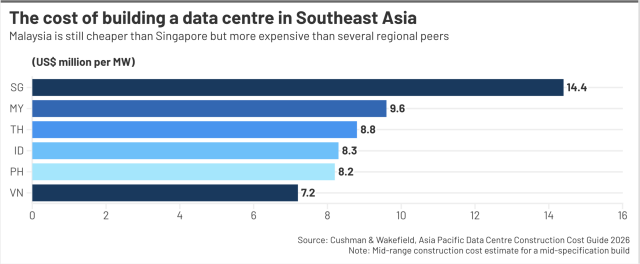
Johor is beginning to face some of the same pressures that made it an attractive alternative to Singapore: rising costs and growing competition for resources. Other markets, meanwhile, are making their own pitch. Cushman & Wakefield estimates that a mid-range data centre costs $9.6 million per megawatt to build in Malaysia, compared with $8.8 million in Thailand and $8.3 million in Indonesia.
DC Byte said it has recorded approximately 556 MW of new live data centre capacity in Malaysia so far in 2026, compared with Australia’s 135 MW, despite Malaysia starting the year with a smaller operational base of 1.1 GW versus Australia’s 1.5 GW.
We asked three market participants to share their perspectives:
The operator view
“Malaysia’s cost advantage (cheap land and power in a low-demand environment) is narrowing as capital concentrates in Johor and tariffs are repriced, but the structural advantages remain. As barriers rise, demand-led execution discipline will separate the winners: good assets on the ground, with real interconnection and contracted demand behind them, will continue to prevail.” Wong Weng Yew, Managing Director, Open DC Sdn Bhd
The investor view
“With Malaysia’s data centre market now well established, the question for investors is no longer cost advantage, but how quickly it can secure the power to support AI-scale demand. At stake is whether the grid, renewables, and policy can keep pace with the pipeline. That makes energy and digital infrastructure a single investment case.”
Ivan Chern, Managing Partner of Seraya Partners.
The analyst view
“Data centre development costs have risen across the industry, and Malaysia is not alone in facing these pressures. While cost has historically been one of Malaysia’s advantages, its attractiveness as a data centre destination extends beyond pricing. The availability of contractors, speed of project delivery, supporting infrastructure and government support have also helped position Malaysia favourably against other APAC markets.”
Vivian Wong, Lead Analyst APAC at DC Byte
For investors, the opportunity may be splitting in two.
In Johor, the prize could increasingly be an established asset with power, connectivity and customers already secured. As Open DC’s Wong Weng Yew puts it, projects with “real interconnection and contracted demand” will continue to prevail.
Higher costs don’t appear to have dampened investor interest. Mark Fong, CEO of Empyrion Digital, told DealStreetAsia that Malaysia’s cost structure is evolving alongside customer requirements, and “the continued strong flow of capital into Malaysia reflects the strength of the market and remains a compelling market for hyperscale and AI-ready infrastructure.”
“Ultimately, Malaysia’s long-term competitiveness will depend not just on cost, but on its ability to deliver capacity reliably and at the pace required by customers,” Wong of DC Byte told DealStreetAsia.
Elsewhere, the opportunity may be to enter at a lower cost, but with more work to do to secure the infrastructure and demand that make a project viable.
The next Johor may be cheaper to enter. The first one may be harder to replicate.
Market roundup
Jelawang picks two more managers: The Khazanah-owned fund-of-funds is said to have selected Singapore’s Sitara Capital and Malaysia’s Bintang Capital for its Emerging Managers’ Programme.
IFC weighs Affin financing: The development finance institution is considering up to $400 million in financing for Affin Bank to support lending to small businesses.
Big Caring advances IPO plans: The Creador-backed pharmacy group has signed a retail underwriting agreement with three banks ahead of its proposed Bursa Malaysia listing.
SkyeChip joins AI memory project: The Malaysian chip designer is working with SoftBank subsidiary SAIMEMORY on next-generation memory for AI.
Vynn Capital closes second fund: The Malaysian venture firm is targeting 13–14 portfolio companies. Its limited partners include KWAP and Jelawang Capital.
Summit updates
The conversations in this newsletter are coming to life in Kuala Lumpur. On 28 January 2027, we’re bringing together investors, founders and industry leaders for DealStreetAsia’s Malaysia Capital and Growth Summit.
We’ll get into the questions shaping the market: How far can state capital take Malaysia’s businesses? Can the country power its data centre ambitions? And where does the investment opportunity lie as its semiconductor industry moves up the value chain?
There’s more to come as we build the agenda. More panel sessions, fireside chats, and keynotes will be added soon.