
Foreign buyers lifted Southeast Asia’s tech M&A market in 2025, but the headline rebound masked a retreat by domestic acquirers and offered little relief to the region’s crowded exit pipeline, according to DealStreetAsia DATA VANTAGE’s latest report SE Asia Tech M&A Review: 2026.
The region recorded 129 transactions, up 7.5% from 2024 and ending two consecutive years of decline. Activity nevertheless remained 10% below 2023 and 41% short of the 2022 peak, making it the third-lowest annual deal count since 2018.
Rather than signalling a meaningful exit recovery, the report suggests that the market has settled at a lower level of activity.
Semesterly trends reinforce this view. H1 2025 was broadly flat year on year at 65 transactions, while H2 rose 18.5% to 64 deals against a particularly weak comparable period. With virtually no sequential growth, much of the improvement reflected a favourable base effect rather than accelerating momentum.
Valuation resets helped narrow pricing gaps and kept strategic sales, tuck-in acquisitions, and acqui-hires moving, the report finds. Buyers nevertheless remained highly selective, focusing on assets with clear strategic value, defensible capabilities, or a strong operational fit. Persistent valuation mismatches and extended diligence continued to constrain deal conversion.
Early 2026 data point to renewed downside risk. H1 produced 41 transactions, down 37% year on year. Reporting lags may improve the final tally, but H2 would still need to deliver 88 deals, more than twice the first-half volume, for the year to match 2025. The modest rebound has yet to develop into a sustained M&A cycle.
Exit overhang persists
Acquisitions involving PE- and VC-backed tech companies recovered in 2025, but offered limited relief for Southeast Asia’s crowded exit pipeline, according to the tech M&A report. Deal volume rose to 51 from 44 in 2024, lifting sponsored targets’ share of total activity to 39.5% from 36.7%.
The report shows that sponsored deal volume remained 45% below the 2022 peak of 93 transactions and slightly lower than the 53 recorded in 2023. The correction has effectively returned activity to pre-boom levels.
Notable transactions included beauty commerce platform Sociolla, renewable energy developer Alba Renewables, and shared mobility company Neuron Mobility. The range of targets reflects continued buyer interest across consumer technology, green infrastructure, and mobility, although acquisitions remained selective.
The prolonged funding downturn has created more potential sellers as founders and investors face mounting liquidity pressure. Yet relatively few portfolio companies have converted into acquisitions, suggesting valuation resets alone have not been enough to unlock the market. Asset quality, deal readiness, and buyer selectivity remain key constraints.
The report recorded just 14 sponsor-backed targets acquired in H1 2026, including Avanseus and Timo. These represented 34.1% of regional tech M&A volume. While reporting lags may improve the final tally, the figures point to increasingly scarce liquidity events for regional investors.
Buyer mix tilts cross border
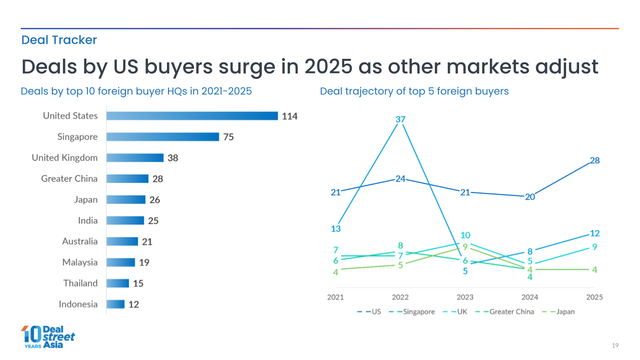
Foreign buyers strengthened their grip on Southeast Asia’s tech M&A market in 2025, the report finds. Acquirers based outside the target’s home market completed 87 transactions, representing 67.4% of total deal volume, while domestic buyers contributed the remaining 32.6%.
This marked a sharp shift from the 57.5%–42.5% split in 2024 and created the widest annual gap in the series. Foreign acquisitions rose 26.1%, while domestic activity fell 17.6% to its lowest annual total.
The widening gap, therefore, not only reflected stronger foreign interest, but also weaker buying capacity among local companies. Funding constraints and pressure to prioritise profitability have left many regional tech platforms conserving cash rather than pursuing acquisitions.
Valuation resets, meanwhile, created opportunities for better-capitalised foreign strategics to acquire market access, specialist technology, and talent. Yet, foreign deal volume remained below 2022 and 2023, showing that its record share did not represent a return to peak cross-border activity.
The imbalance widened further in H1 2026, when foreign buyers completed 30 transactions, or 73.2% of the total, compared with 11 domestic deals. However, activity remained subdued across both groups, reinforcing the view that foreign dominance is growing within a smaller overall market.
Strategy shapes dealmaking
Executives interviewed for the report said the current market favours disciplined acquirers with clear strategic filters, patient capital and the capacity to integrate and scale targets. Their acquisition track records also show that selective buyers can continue deploying capital despite the broader market slowdown.
Tomas Urbanec, the CEO of Ascend Asia, which completed four acquisitions within a year, said that capital is not a constraint.
“The more important consideration is identifying partners that share our vision and goals, and whose governance and compliance standards align with ours,” Urbanec said.
Separately, Catcha Digital CEO Eric Tan, whose company completed seven acquisitions in 2025, among the most active in the region, sees the cautious market as an opportunity for patient buyers, as valuations and founder expectations become more realistic.
“Southeast Asia remains one of the few regions in the world where digital infrastructure, consumer behaviour, and business-to-business digitisation are all still in relatively early innings simultaneously,” he said.
Ang Lip Kian, principal for M&A and private equity at Baker McKenzie Wong & Leow, said the growing supply of M&A opportunities had yet to translate into a significant increase in completed deals. Geopolitical uncertainty, volatile energy markets and high valuations in some sectors are slowing transactions, while buyers are scrutinising financials more closely and negotiating stronger downside protection.
“We do expect trade sales and secondary transfers to continue serving as an important exit route for investors of venture-backed companies.”
Read the SE Asia Tech M&A Review: 2026 report for insights into:
- Tech M&A deal volume in Southeast Asia since 2018
- Contribution of PE/VC-backed companies to tech M&As
- Top M&A deals with disclosed deal value in 2025
- Tech M&As broken down by headquarters and verticals