Indonesian e-commerce giant Bukalapak swung to a profit in 2025, supported by strong revenue growth across its core business segments and gains from investment revaluations.
The Jakarta-listed company reported a net profit of 3.15 trillion rupiah ($185.9 million) for the year ended December 31, 2025, reversing a net loss of 1.55 trillion rupiah ($91.5 million) in 2024, according to its audited financial statements filed with the Indonesia Stock Exchange (IDX).
In Q4 2025, the company’s net profit surged 124% to 235 billion rupiah, compared with a loss of 955 billion rupiah in the same period a year earlier. The company reported positive net income in each quarter of 2025, with the largest contribution coming in the third quarter when profit reached 2.44 trillion rupiah, supporting the full-year turnaround.
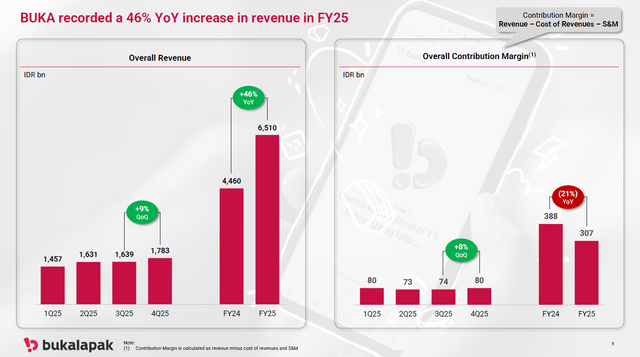
The turnaround came as net revenue climbed 46% year-on-year to 6.51 trillion rupiah in 2025, compared with 4.46 trillion rupiah a year earlier, driven mainly by growth in the company’s gaming business.
“2025 is an important moment for us to strengthen the company’s foundation by focusing on strategies that can deliver long-term value to our stakeholders,” said Bukalapak director Victor Putra Lesmana in a statement on Friday.
Bukalapak also reported a sharp improvement in profitability at the operating level. Adjusted EBITDA losses narrowed from negative 340 billion rupiah in 2024 to 62 billion rupiah in 2025, while the fourth quarter posted 9 billion rupiah, bringing the company close to breakeven.
Lesmana said the company is now focusing on strengthening its business fundamentals rather than chasing rapid expansion. “We are prioritising sustainable growth and building a healthier business structure that can create long-term value,” he said.
Investment gains lift profitability
Bukalapak’s return to profitability was largely supported by investment-related gains during the year.
The company recorded 2.37 trillion rupiah in net investment gains, compared with a 1.54 trillion loss in 2024, helping lift operating profit to 2.42 trillion rupiah, versus an operating loss of 2.51 trillion rupiah a year earlier.
The company’s results presentation noted that part of the improvement was linked to mark-to-market gains from Bukalapak’s investment in Allo Bank, which contributed to a stronger adjusted EBITDA performance.
Even so, Bukalapak’s core business continued to operate with relatively tight margins. Cost of revenues rose to 5.99 trillion rupiah, up from 3.74 trillion rupiah in 2024, reflecting higher transaction volumes across its ecosystem.
Operating efficiency improved during the year, with selling and marketing expenses falling to 212.7 billion rupiah and general and administrative expenses dropping to 490.1 billion rupiah, down sharply from 1.45 trillion rupiah a year earlier.
Gaming continues to be the main motor
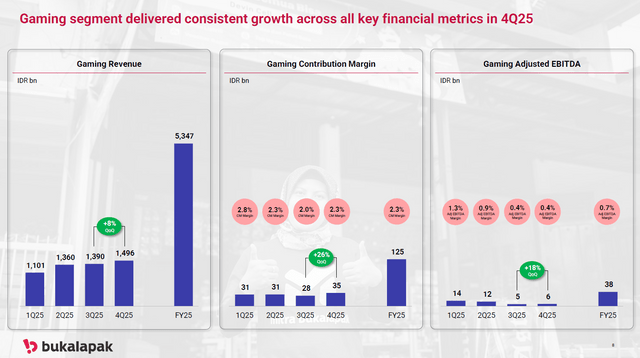
Bukalapak’s gaming segment emerged as one of the strongest growth drivers during the year. The segment, which includes digital gaming marketplaces such as Itemku and Lapakgaming, generated 1.5 trillion rupiah in revenue in the fourth quarter of 2025, growing 8% quarter-on-quarter, and accounting for 83.6% of the company’s total quarterly revenue.
For the full year, the segment contributed 5.34 trillion rupiah, or about 82% of the company’s total revenue.
Bukalapak said the growth was driven by improved marketing strategies and stronger transaction activity toward the end of the year.
Gaming has become a central pillar of Bukalapak’s ecosystem strategy, with the company focusing on digital products such as in-game currency and gaming vouchers.
Other Bukalapak’s unit—Mitra Bukalapak, investment, and retail—also recorded growth across its other business lines.
The Mitra Bukalapak segment, which provides digital products and services to small retailers across Indonesia, generated 191 billion rupiah in revenue in the fourth quarter, rising 12% quarter-on-quarter.
Meanwhile, the investment segment, operated through the B-Money platform, posted one of the fastest growth rates, with revenue rising 39% quarter-on-quarter to 25 billion rupiah as transaction volumes and investor participation increased.
Bukalapak’s retail segment contributed 74 billion rupiah in revenue in the fourth quarter, supported by year-end demand and inventory clearance campaigns aimed at improving stock turnover.
The company ended the year with a solid liquidity position. As of December 31, 2025, Bukalapak held 16.21 trillion rupiah in cash and cash equivalents, up from 11.23 trillion rupiah in 2024.
Total assets stood at 26.03 trillion rupiah, while total liabilities remained relatively low at 717.3 billion rupiah, leaving the company with significant financial flexibility.
The company said it has 17.8 trillion rupiah in cash, cash equivalents and liquid investments, which provides ample capital to support innovation and long-term growth initiatives.