This issue recaps the key issues and opportunities that are top of mind for investors in emerging markets.
But first, a quick look at how Singapore is doubling down on efforts to combat the impact of climate change, as an issue of national security and competitiveness, even as “some other governments are scaling back their climate ambitions”, as Prime Minister Lawrence Wong asserted during the Budget speech this past week.
- Singapore has the highest carbon tax rate in Asia. The rate has been raised to S$45 per tonne for this year and next, to reach S$50 – S$80 per tonne by 2030. Yet, cognisant of the global challenges in this space, the Singapore government is also ready to keep the tax “towards the lower end” of that spectrum.
- The solar deployment target has been raised to 3 gigawatt-peak by 2030, after the previous target of 2GW-peak was reached ahead of schedule.
- Singapore is importing low-carbon electricity from around the region, though it also acknowledges that not all efforts will materialise. There are also moves to further diversify the energy mix, including hydrogen and nuclear power.
- The city-state aims to achieve 100% ‘cleaner energy vehicles’ by 2040, and electric vehicle charging infrastructure is being expanded nationwide.
- For the key hard-to-abate sectors of aviation and shipping: A target of 1% of sustainable aviation fuel use for flights departing the city-state this year, and Singapore will be among the first countries in the world to supply ammonia commercially as a fuel for international shipping.
The emerging market opportunity in climate investment
The climate opportunity remains vast, underpinned by energy security and structural demand growth. But amid the broader global economic and geopolitical challenges, investors are turning pragmatic and selective, according to speakers at the recent DealStreetAsia Indonesia PE-VC Summit 2026.
Here are three takeaways from the session on ‘How emerging markets can lead in climate action’:
- Tightening liquidity: Capital recycling turns critical
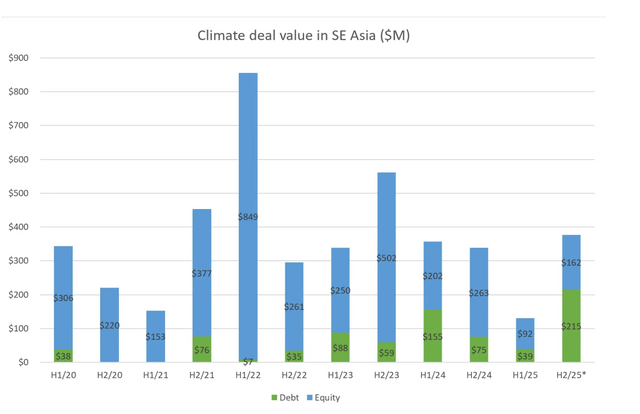
One of the world’s biggest allocators to emerging markets has sounded caution that, even as the need to invest in climate mitigation and resilience in Asia remains critical, there is a lot less capital available. This is particularly so from North American and European sources, compared to just two years earlier.
“It’s much harder to execute on the things that need to be built out,” said Rohit Anand, Head of Asia Infrastructure and Climate Direct Investments at British International Investment.
“The other implication is that since the world is heading in a direction where each country is looking out for its own interests, more energy independence will become at the top of everyone’s mind,” he added.
“Many countries that depend on others for importing energy will want to secure themselves, which means that they have to build their own capacities. So we see the need increasing, and the supply of capital decreasing.”
And, given that the industry is capital-intensive, that means capital recycling becomes more important, even as the overall private fundraising and liquidity environment remains challenging.
“It’s becoming harder to exit, but there is no other way to have a sustainable business if we don’t. So we’ve seen across the board, both in direct as well as via the GPs, there’s much more focus on exits. And second, some products which are self-liquidating, like credit, where there’s a natural end of life to the investment, are becoming more popular.”
 Source: DealStreetAsia’s DATA VANTAGE
- No moonshots: Climate investing as mainstream, pragmatic
To be sure, when the PE-VC industry was flush with liquidity, there were actually situations that made it tougher for some investors, noted Winston Mandrawa, Managing Director and Head of ASEAN at Affirma Capital.
“At certain stages, you’ve got excessive levels of capital chasing too few deals, which then leads to probably excessive valuations. It then makes it more difficult when you think about the broader journey and having to exit.”
As such, climate investing is entering a more disciplined phase, as tighter capital markets, geopolitical fragmentation, and surging energy demand reshape how and where money is deployed.
“The era of cheap capital and white noise is over,” said Li Tan, co-founder and general partner of Audacy. Rather than chasing moonshot technologies, investors are increasingly focused on scalable, commercially viable solutions. “Whatever we are backing, it has to have a way to scale. If not, then we’re not seeing the impact.”
In fact, climate investing is not a category, but core to energy, food, mobility, and industrial systems, the speakers said.
At the same time, investors’ thinking on risks in the sector, particularly in emerging markets, is also evolving. “We are also seeing Western markets behave like emerging markets. There is no predictability anymore,” said LeapFrog Investments’ Partner and co-head for the firm’s climate strategy, Nakul Zaveri.
“We are seeing people thinking about not climate, but transition,” Zaveri added. “It’s forcing societies to rethink consumption, [energy] generation, [and] building cities.”
To that end, investors are prioritising segments such as recycling and traditional food and agri businesses that integrate tech for adaptation and resilience.
“The real value for returns, as well as climate impact, is in traditional agriculture companies [instead of tech-focused companies],” said Uday Garg, founder and managing partner of Mandala Capital.
“In food and agri, tech is very hard to actually commercialise and produce anything. But in traditional businesses, such as in the food distribution or value chain, it’s easier to incorporate technology.”
- The ‘green leap’: Compelling returns to be found in Asia
Ultimately, emerging markets will drive global growth, with demand for energy, consumption, and mobility to rise exponentially. And while that will be accompanied by increased emissions, it also presents investors with superior risk-adjusted return opportunities, tied to access to the essentials.
The key areas are in a resilient and efficient energy supply, food and agricultural systems, and core infrastructure and industrial systems that can decarbonise while scaling up.
Indeed, a major aspect of this is the so-called green leap. Emerging markets can skip over the legacy, fossil fuel-heavy paths to development that the West used, to what is already cleaner and cheaper technologies from the start: Renewable energy, electrification, and climate-resilient and efficient food and agri systems enabled by precision technology.
For one, there remains a major gap in adaptation financing in Asia. Garg shared that even a major, dedicated allocator such as the Green Climate Fund struggles to find private sector adaptation plays. And that gap presents an opportunity for investors who can structure and underwrite adaptation in real economy businesses.
Added Zaveri: “Emerging consumers can rise on the back of the green leap only if decarbonisation and resilience aligns itself to growth [and] to energy security in our markets. We see that incrementally happening: 65% of technologies needed now have what we call a ‘green discount’, which is cheaper than the incumbent, [and] which is very clearly moving towards affordability.
Top climate deals
Temasek-linked Fullerton Fund Management marked its first climate fund investment in Southeast Asia with a transaction involving Pyro Energie, a Thailand-based recycler of end-of-life tires.
Norfund is investing $4 million in Circular Plastics Company, a PET recycling company in Vietnam.
Affirma Capital is investing about $35 million to acquire an Indonesian renewable energy platform operating utility-scale mini hydro and solar projects.
KKR is investing up to A$603 (about $416 million) in the energy transition platform of HMC Capital, an Australia-listed alternative asset manager.
Battery recycling firm Green Li-ion halved its losses in the financial year ended April 2025, supported by early-stage income from its US facility and payments from its licensing business.
Vertex Ventures Southeast Asia & India sold a portion of its stake in Indonesian aquaculture startup Aruna to East Ventures.
Swiss impact asset manager responsAbility has received a 200-million-euro ($239 million) PE investment mandate from Stella Vermögensverwaltungs GmbH, the investment entity of the Heinz Hermann Thiele Family Foundation and Julia-Thiele Schürhoff. The strategy will invest over the long term in growth-oriented companies in Africa, Asia, and Latin America.