As Indonesia’s startup ecosystem continues to recalibrate after years of easy capital, the country’s established corporates seem to be faring notably steadier. The growth model of legacy businesses, shaped less by funding cycles and more by profitability, has helped them stay on course despite market turbulence.
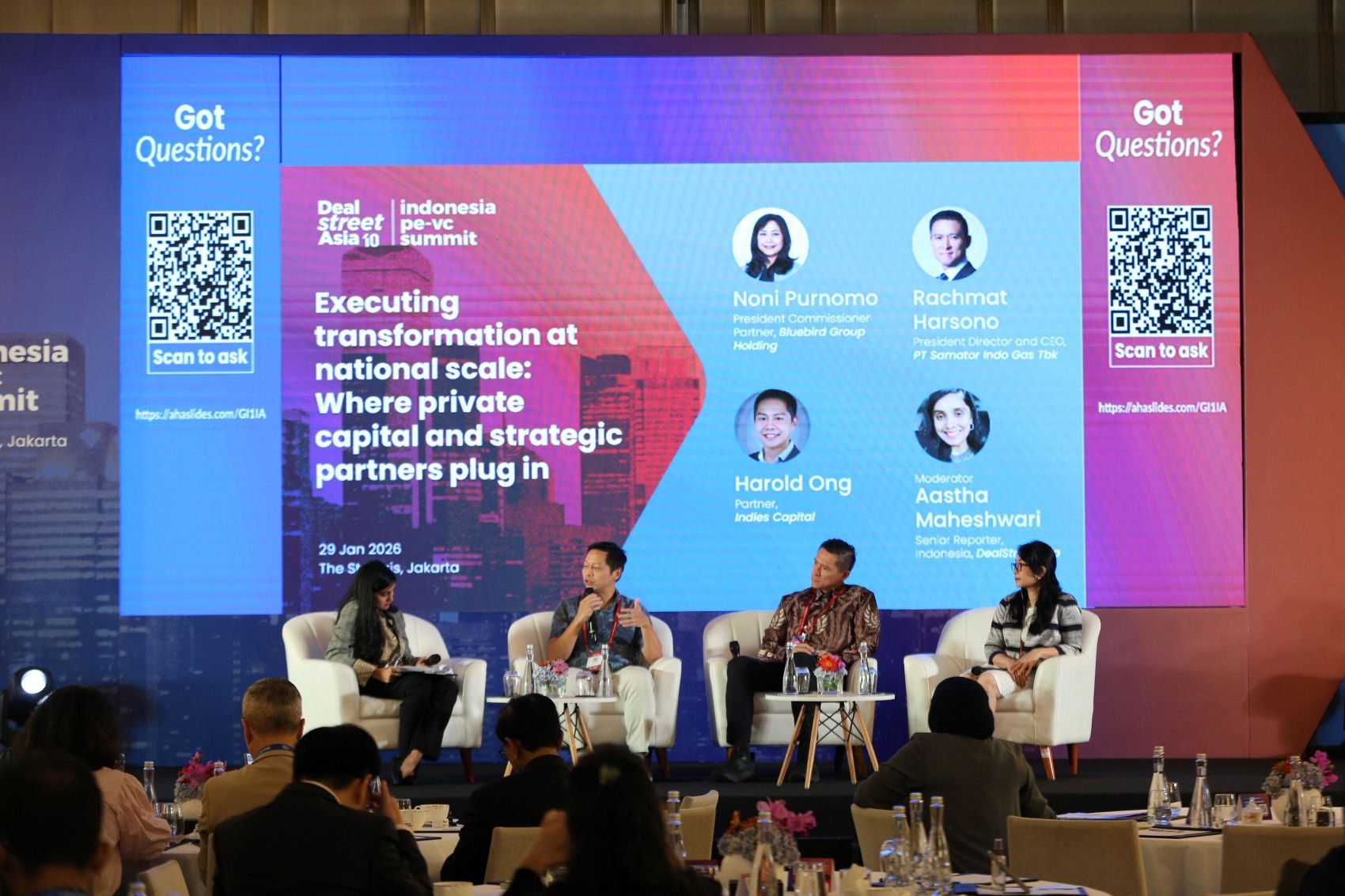
During a session titled “Executing transformation at national scale: Where private capital and strategic partners plug in”, at DealStreetAsia’s Indonesia PE-VC Summit 2026 in Jakarta last week, panellists spoke of transformation as something incremental, internally funded, and tested over time.
Noni Purnomo, president commissioner of Bluebird Group Holding, said that steadiness reflects how the company has been run for decades. “Since the very beginning, we always believed that for us to be sustainable, we have to focus on being profitable,” she said, noting that Bluebird reached profitability by the mid-1970s, only a few years after it was founded.
That early discipline, she added, shaped how the company approached every subsequent strategic shift. “Every time we want to launch a new strategy, we always think of the bottom line as well. We have to be able to sustain ourselves.” The approach proved decisive during periods of stress.
“During the 1998 crisis, we managed to grow very rapidly straight after. Actually, our biggest growth was between 2001 and 2004,” Purnomo said. “During Covid, we managed to float around, and then we managed to grow again.”
Those experiences have left Bluebird cautious about transformation driven by external trends rather than internal readiness. Purnomo warned that technology-led change can easily go wrong when it is detached from governance and financial capacity.
“A lot of times, people are driven by the latest type of technology,” she said. “But if we’re driven by the latest technology instead of what we actually need—and what we can afford—we lose direction.”
Instead, she argued, transformation needs to start with governance and clarity of objectives. “We won’t be able to make the right transformation if we don’t have good governance in place,” Purnomo said.
In Indonesia, she added, execution is often complicated by ownership structures. “The hardest part to execute in Indonesia is to make sure that the shareholders are on board with you,” particularly in family businesses.
Capital-intensive sectors leave little room for experimentation
The emphasis on fundamentals was echoed by Rachmat Harsono, president director and CEO of PT Samator Indo Gas Tbk, whose business operates at the other end of the economic spectrum—capital-intensive, infrastructure-like, and largely insulated from consumer sentiment.
Harsono described industrial gas as “boring, but indispensable.” Samator supplies thousands of customers and serves roughly 80% of hospitals across Indonesia, including those in remote areas. That footprint places the company squarely within Indonesia’s broader industrialisation agenda.
Looking ahead, Harsono pointed to sectors aligned with national priorities, including critical minerals, advanced materials, photovoltaics, semiconductors, healthcare, and energy. “We just recently secured a 50-year contract with one of the largest semiconductor companies in Indonesia,” he said, underscoring the long investment horizons involved.
But those opportunities come with financial constraints. Unlike venture-backed businesses that expanded rapidly during the peak funding years, industrial operators like Samator were built with balance sheet durability in mind. “We have to be smart to combine people, technology, and finance,” Harsono said, noting that cheap infrastructure funding is no longer as readily available as it was five years ago.
The company has relied on blended financing structures that combine equity and debt. “That’s the reason why we use blended financing,” he said, describing capital discipline not as a brake on growth, but as a requirement for scaling sustainably.
Alignment matters more than acceleration
From the investor side, Harold Ong, partner at Indies Capital, offered a view shaped by deal-making across cycles. While macro uncertainty has slowed deployment, he said Indonesia continues to offer opportunities—particularly in infrastructure-linked sectors and domestic consumption.
“At the end of the day, we are still a very large consumption economy,” Ong said. But he was candid about the current environment. “We currently see a slower growth cycle,” he added, noting that selectivity has become unavoidable.
For investors, Ong argued, success increasingly depends on alignment rather than structure. Clear expectations, shared philosophy, and trust matter more than headline terms—especially when working with family-controlled companies. “You have to very clearly state what you’re going to do.”
That investor discipline mirrors what many established corporates have long practised. While startups are now being pushed to demonstrate unit economics after years of expansion, the companies on stage described operating models that were never built on sustained losses or abundant external funding.
Sustainability with commercial discipline
Harsono also pushed back on broad-brush sustainability narratives, arguing that green investments need to be commercially viable to endure. “Sustainability is not a vagueness of science,” he said.
“It has to make economic sense.” Using hydrogen as an example, he cautioned against premature adoption. “If green hydrogen costs four to five times more, does it make sense or not? It depends on whether the ecosystem is ready.”
In the case of Bluebird, which has been experimenting with electric vehicles since 2009, Purnomo said scaling has been constrained by capital requirements and resale values. “For us, what’s most important is how to make it work financially,” she said.
Rather than forcing adoption, Bluebird is recalibrating—deploying EVs where demand and economics are clearer, including corporate and public transport partnerships. “Now we’re trying to make it faster by growing our model, not just one day, one electric car,” she said.
In a market defined by currency volatility, tighter capital, and heightened scrutiny, panellists returned to the fundamentals of execution, governance, and people.