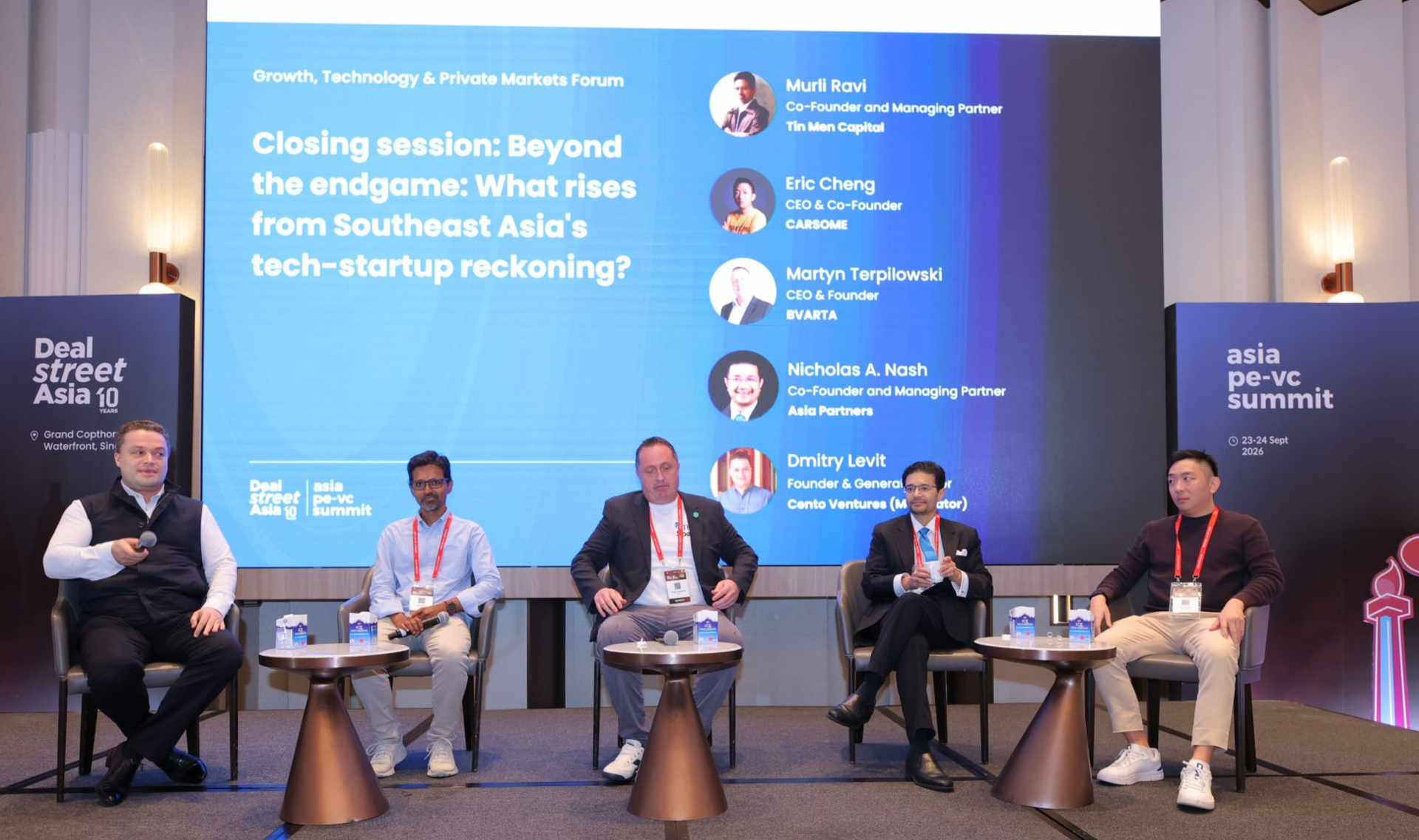
Southeast Asia’s technology ecosystem is emerging from a painful funding correction that has forced investors and founders to rethink growth-at-all-costs strategies, speakers at DealStreetAsia’s Asia PE-VC Summit 2026 in Singapore said.
The region has struggled in recent years with weaker funding, fewer large exits and a reassessment of valuations that had surged during the technology boom. But investors and entrepreneurs at the summit said the reset is creating a pipeline of more durable companies, particularly in enterprise technology and businesses that use technology to solve traditional industry problems.
“One common theme among successful Southeast Asian companies is that they know how to apply technology very well to solve real-world problems and fix real-world inefficiencies,” said Eric Cheng, co-founder and Chief Executive of Malaysian used-car platform Carsome.
“Companies in Southeast Asia need to combine technology with operations, supply chains and regulatory expertise rather than simply replicate Silicon Valley’s technology-led model.”
Carsome, which operates across Malaysia, Indonesia, Thailand and Singapore, has expanded beyond its original marketplace model into financing, insurance, logistics and other services.
Cheng said entering a new Southeast Asian country could be similar to founding another startup because of differences in infrastructure, regulation and market dynamics.
Nicholas Nash, co-founder and Managing Partner at Asia Partners, said the funding correction has exposed structural weaknesses in the region’s technology ecosystem, including a shortage of large pools of follow-on capital.
He also said Southeast Asia has fallen behind in the first phase of the artificial intelligence boom.
“Southeast Asia has completely missed Round 1 of the boxing match of AI.
“Now, don’t get too depressed, there’s going to be Round 2, there’s going to be Round 3, there’s going to be Round 4. But I think we’ve got to call it what it is. We’ve completely missed the first round of the semiconductor silicon side of AI,” Nash said.
He said the region could still benefit from subsequent waves of AI adoption, particularly by applying the technology to established businesses and industries rather than attempting to compete directly with US companies developing foundational AI infrastructure.
Nash also argued that Southeast Asia needs to build companies at a larger scale to access deeper global capital markets.
The availability of investment rounds of $100 million or more has fallen significantly from earlier years, making it harder for companies pursuing regional expansion strategies to secure the capital required to reach the scale needed for major public listings.
Nash said the threshold for meaningful US listings has also risen, forcing founders and investors to consider whether building a multibillion-dollar company was realistic or whether other exit routes would be more appropriate.
Murli Ravi, co-founder and managing partner at Tin Men Capital, said the funding downturn was forcing venture capital managers to become more disciplined.
“The managers are getting realistic with themselves. If we make mistakes, you can’t do it twice, three times, four times without getting called out. “Over time, you can’t pull the same funds again. So let’s do things the right way the next time.”
Tin Men focuses on enterprise and frontier technology serving traditional sectors such as manufacturing, agriculture, logistics and construction.
Ravi said Southeast Asian startups did not necessarily need to become billion-dollar companies to generate attractive returns.
Businesses that require less capital and allow founders to retain larger ownership stakes could produce strong outcomes for both entrepreneurs and investors, he said.
He also highlighted a growing model in which Southeast Asian companies target developed markets outside the US, including Japan, Australia, Hong Kong and the Middle East, where they may face less competition from heavily funded US startups.
Martyn Terpilowski, founder and Chief Executive of location intelligence software company BVARTA, said enterprise technology was overlooked during the region’s previous startup boom because investors were more focused on consumer platforms and large addressable markets.
Terpilowski, whose company operates across Southeast Asia and Japan, said business-to-business companies could build sizeable businesses with less capital because they spend less on consumer advertising and can expand through direct relationships with corporate customers.
“I think now is a great opportunity to reset. And I think we need to look at the lot of smart people out there who can really grow businesses.”
The discussion also highlighted concerns over misaligned incentives during the previous funding boom, when venture firms faced pressure to deploy capital and founders were rewarded for rapid growth rather than profitability.
Ravi said his firm did not make a single investment in 2021, a decision he said reflected its unwillingness to participate in a market where valuations and deal incentives had become detached from fundamentals.
The current environment is forcing managers to become more selective, he said, with limited capital making it harder to repeat mistakes.
Cheng said the same discipline is increasingly being applied to artificial intelligence.
For companies such as Carsome, Cheng said AI should be judged by its impact on revenue per employee, cost to serve and other operating metrics rather than by whether a company can market itself as an AI business.
The panellists agreed that Southeast Asia’s technology sector is unlikely to follow a single path to success and that some companies may pursue multibillion-dollar valuations and US listings, while others could generate strong returns through strategic sales, regional expansion, or smaller-scale businesses with high founder ownership.