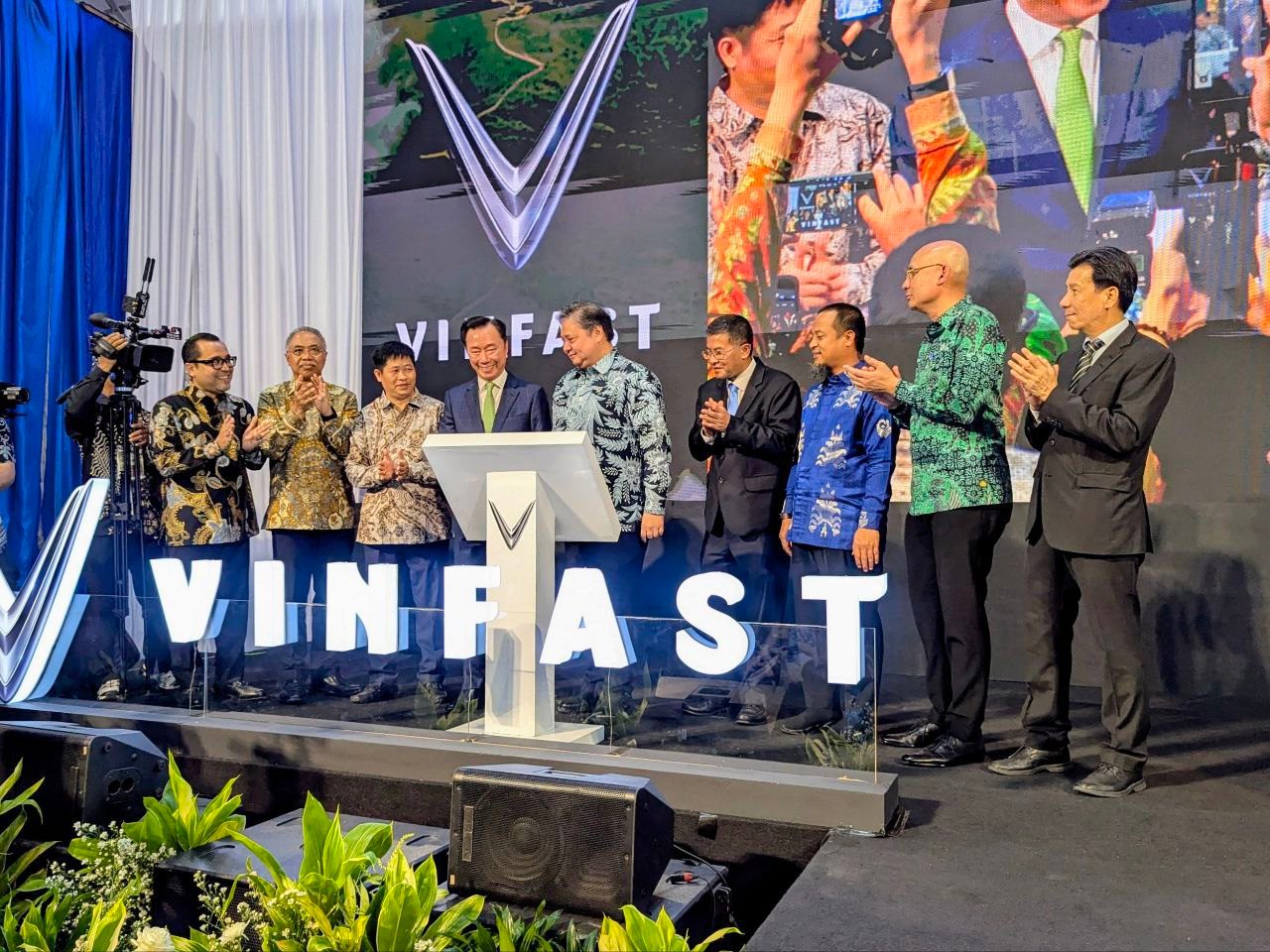
Vietnamese electric vehicle maker VinFast plans to commit more than $1 billion in additional investment to expand its Indonesia manufacturing footprint, lifting annual production capacity to as much as 350,000 units, as it deepens its long-term bet on Southeast Asia’s largest auto market.
The commitment comes on top of the roughly $300 million VinFast has already invested in its Subang facility in West Java, as part of an earlier $1.2 billion commitment announced in July 2023, to build a plant that sits on a 171-hectare plot, which will be developed in three phases.
The first phase, covering around 9–10 hectares, currently has an installed capacity of 50,000 units per year and employs about 900 local workers, according to company executives speaking at the factory’s launch on Monday.
Pham Sanh Chau, CEO of Vingroup Asia operations, said the additional capital is required to support a sevenfold increase in capacity. “At the moment, our investment of $300 million only allows us to produce 50,000 units. To increase capacity to 350,000 units per year, we need to significantly raise our total investment,” he said.
According to country CEO Kariyanto Hardjosoemarto, VinFast’s total investment commitment could ultimately exceed $1 billion once all phases of the Subang site are fully utilised. If phases one through three are completed, the facility could absorb between 5,000 and 15,000 workers, depending on production needs.
Workforce recruitment will prioritise local hires from Subang and the wider West Java region, alongside technology transfer initiatives for surrounding communities.

Production volumes will be calibrated to market demand, Hardjosoemarto said. The first phase will assemble passenger vehicles ranging from the VF3 to VF7, while future phases could support both higher four-wheeler output and the assembly of electric two-wheelers. A locally developed MPV is also being prepared, with VinFast seeing strong potential for the segment in Indonesia.
While VinFast intends to prioritise the domestic market in the early stages, Chau said the company selected Indonesia with exports in mind, particularly to right-hand-drive markets in Southeast Asia, once local demand has been met. Export volumes, however, will be determined after the company assesses market absorption following the start of mass production.
The company expects to begin large-scale production as early as next month. Chau said VinFast will monitor demand absorption closely before deciding how many units can be allocated for overseas markets.
Country CEO Kariyanto Hardjosoemarto added that production volumes will be adjusted to market demand, with the facility initially assembling models ranging from the VF3 to VF7. The plant is also designed to support future two-wheeler assembly, while a locally developed MPV model is seen as having strong potential in Indonesia.
Beyond manufacturing, VinFast is positioning its Indonesia push as a full electric-vehicle ecosystem play. The company highlighted its in-house charging infrastructure arm, V-Green, which has installed more than 2,000 charging points nationwide, and will continue to expand. VinFast is also offering free fast-charging to customers until March 2028.
To address concerns around EV resale values, VinFast has introduced a buyback guarantee, offering up to 90% of the original pre-tax price after six months of use and 70% after three years. The group also operates a taxi business, Green SM (Xanh SM), which is active in Jakarta, Surabaya, and Makassar and is expected to expand to other major cities.
While Green SM (Xanh SM) is considered an important potential customer, Chau said sales volumes to the taxi operator remain undecided and will depend on commercial terms, noting that Green SM is not a VinGroup subsidiary and currently benefits from tax-free vehicle imports due to its public transport status. The taxi operator made its debut in Indonesia in late 2024.
Battery investment is not included in the $1 billion commitment, Chau said. Instead, VinFast plans to meet its localisation targets through local procurement, including batteries sourced from Gotion Indonesia. The automaker has committed to raising local content to 40% by 2026, 60% two years later, and 80% thereafter, with batteries accounting for nearly 30% of vehicle value.
Hardjosoemarto added that VinFast’s decision to invest in Indonesia was driven by long-term business considerations rather than short-term incentives, even as the company continues to utilise government schemes tied to production commitments.
“With the scale of investment we’ve made, there is only one option for us,” Chau said. “We have to succeed, and we have to grow together with Indonesia.”